


7 Card Stud is a poker variation that takes lots of practice to master. Players at the table, which allows a maximum of 8, are dealt 7 cards and must make the best 5-card hand out of them to win. On this page, we will guide our Kuwaiti readers wanting to take on 7 Card Stud through its rules, hand rankings, tips to win, and how it differs from other major poker variations.
Top Sites to Play 7 Card Stud

Bonus up to
$3,500

Bonus up to
$5,000

Bonus up to
$2,000

Bonus up to
$1,750

Bonus up to
$600

Bonus up to
$1,590

Bonus up to
$20,000

Bonus up to
$1,500

Bonus up to
$2,200

Bonus up to
$200

Bonus up to
€300

Bonus up to
$1,000

Bonus up to
$1,760

Bonus up to
$300

Bonus up to
$1,000

Bonus up to
$2,000

Bonus up to
$1,500

Bonus up to
$5,000
7 Card Poker Rules
| Feature | Detail |
| Max Players | 8 players (including dealer) |
| Deck Used | 52-card Standard Deck |
| Joker | No |
| Total Cards Dealt | 7 cards per player (3 face-down, 4 face-up). |
| Community Cards | No |
| Hand Size | 5 cards |
| Forced Bets | Antes (everyone pays) and a Bring-in (lowest card pays). |
| Betting Style | Fixed Limit (Small bets early, Big bets later). |
| Betting Rounds | 5 rounds (3rd, 4th, 5th, 6th, and 7th Street). |
| Strongest Suit | Spades ♠ |
| Weakest Suit | Clubs ♣ |
| Blinds? | No blinds. There is the “Bring-in” instead |
 Fun Fact About Seven-Card Stud
Since 7 Card Stud uses a standard 52-card deck, if all 8 players stay until the last round, that means 7 × 8 = 56, which exceeds the deck by 4. In this case, the dealer puts one single community card face-up in the middle of the table that everyone shares for their final card. It’s the only time “Stud” ever looks like “Hold’em.”
How to Play 7 Card Stud: A Step-by-Step Guide
7 Card Stud poker is a poker variation that can take you a lifetime to master. The rules can also be a bit intimidating at first. The rounds here are called streets, and it is different from Texas Hold’em, so read carefully below on how to play poker 7 Card Stud, as this is not an easy one.
The Buy-In and The Ante

Before any round begins, all 8 players have to pay the ante, which is a forced bet on all players, unlike in Poker Texas Holdem where only two pay the blinds.
Note: The ante amount is set by the casino. It is usually standard at 10% of the small bet. So on a table where the small bet is $20 and the big bet is $40, the ante would be $2.
The First Round: Third Street

In the first round, the dealer gives all players two cards face down and one card face up (this card is called a door card). Afterwards, the bring-in player is decided: the one with the lowest face-up card has to start the betting. In case two players have deuces, then the suit determines which is the weakest card (Clubs is the absolute lowest, then Diamonds, Hearts, and Spades).
Note: The bring-in amount is usually a fraction of the small bet. The low card player can also complete it instead of bringing in, which means paying the full small bet amount.
The Fourth Street: The First Up-Card

In this round, everyone is dealt a second card face up. The player showing the highest hand acts first; they can either check or bet. In case the player’s two face-up cards are a pair, they can choose to bet the small bet or jump to the higher limit big bet, thus forcing everyone else to follow that higher bet for the rest of the round.
Note: In this round, the bring-in rule does not apply.
The Fifth & Sixth Streets: Building the Hand

These rounds are crucial, as starting on 5th Street the betting limit doubles. So let’s say you were playing $5/$10; now you have to bet in $10 increments, so the pot gets bigger and many players fold because it is expensive, especially if they can see they have no chance of making a strong hand.
Note: Now that four of your cards are face up, you do have good info on who would have a strong hand. If you need a King to win, but you see three Kings sitting in other people’s hands, your hand is “dead” and you should probably fold.
The Seventh Street

The final card is dealt face down to each player, so now each has 3 hidden cards and 4 visible ones. This is the final betting round, and you bet at the big bet limit, so as we said in the previous round, you will be at $10 increments.
Note: If all players stayed up until this round, the deck is not enough, so the dealer puts one community card in the middle of the table everyone can use as their 7th card.
The Showdown

Assuming that someone bet and someone called, then it is time to show the cards. Each player has 7 cards in total, so they mentally remove the worst two and make the best possible 5-card poker hand. The one with the higher-ranking hand wins.
Note: The suit also does not matter in this round, so for instance, a Spade flush and a Club flush are a tie; you’d split the pot.
Hand Rankings in Seven-Card Stud
In the table below, you will find the ranking of the hands in 7 Card Stud from highest to lowest, of course bearing in mind that the player can make a 5-card hand only. Note that the suits in deciding the winning hand do not matter; the Clubs are not the lowest and the Spades are not the highest. This only applies when deciding who starts the betting.
| Rank | Hand | Description | Example |
| 1 | Royal Flush | A, K, Q, J, 10 all of the same suit. | A♠️ K♠️ Q♠️ J♠️ 10♠️ |
| 2 | Straight Flush | Five cards in numerical order, all same suit. | 9♥️ 8♥️ 7♥️ 6♥️ 5♥️ |
| 3 | Four of a Kind | Four cards of the same rank. | Q♣️ Q♦️ Q♥️ Q♠️ 2♥️ |
| 4 | Full House | Three of a kind plus a pair. | J♠️ J♥️ J♣️ 4♦️ 4♠️ |
| 5 | Flush | Any five cards of the same suit (not in order). | A♣️ 10♣️ 7♣️ 6♣️ 2♣️ |
| 6 | Straight | Five cards in numerical order (any suits). | 5♦️ 6♥️ 7♠️ 8♣️ 9♦️ |
| 7 | Three of a Kind | Three cards of the same rank. | 7♠️ 7♥️ 7♦️ K♣️ 3♠️ |
| 8 | Two Pair | Two different pairs. | A♠️ A♦️ 9♥️ 9♣️ 5♠️ |
| 9 | One Pair | Two cards of the same rank. | 10♥️ 10♦️ K♠️ 4♣️ 2♥️ |
| 10 | High Card | No pairs; the highest single card in your hand. | A♠️ J♦️ 8♥️ 7♣️ 3♠️ |
7 Card Poker Strategies that Will Give You an Edge
Whether you are just learning how to play 7 Card poker or are an advanced player, there are these seven strategies you always need to keep in mind so you stop bleeding your bank account and give yourself a chance to win. 7 Card poker is a slow game, more or less, so many players think to keep playing until the very end, and that is a common misconception. Instead, follow these 7 key poker strategies.
- Face-Up Cards Are Key: It is one of the most important skills in 7 Card Stud poker. Since you will see 4 of each player’s face-up cards on the table, and you see 3 or 4 cards of what you need to make a good hand there, then your hand is probably dead and you better fold.
- Stop Chasing Maybes: Stop playing every hand just to see what happens in the end. From the beginning, if your first three cards do not have any connection—like not even a pair, or suited cards, or three in a row—just fold on 3rd Street or you will lose your money quickly.
- The Door Card Intimidation: If your door card, which is the first face-up card you are dealt, is an important one like an Ace or a King, then you have already established a strong presence on the table. Since players respect high cards, even if your remaining cards are junk, you can win the pot just by betting due to the respect you get.
- Be Careful on 5th Street: The betting doubles from that round on, so it is the point of no return. Thus, if your hand did not improve by the time you got your 5th card, it is always better to fold than to continue paying double with a probably dead hand in the remaining rounds.
- Memory Over Math: Unlike most poker games, Seven-Card Stud does not require math as much as it requires memory because you should remember what cards others have, even after they fold, to know if you ever have a chance of getting the cards you need to make your hand. Strategizing what cards you need, what you have, and what others took is a great advantage in 7 Card Stud.
- The Open Pair Leverage: If you pair your face-up card on 4th Street, you get the option to bet the “big bet” (the higher limit) early. Use this. It’s an aggressive move that forces everyone else to pay a premium just to stay in the hand. It’s a great way to thin the field or win the pot immediately.
- Don’t Chase Second-Best Hands: Let’s assume you have a pair of 9s but someone on the table is showing a pair of Queens. So you are likely losing because Stud is a game of high cards. In Texas Hold’em, you can hope for a turnaround on the next card you are dealt, but in 7 Card Stud you can see the strength in front of you. So don’t go draining your bank account for a second-best hand you won’t win.
7 Card Stud VS Texas Hold’em Poker: What’s the Difference?
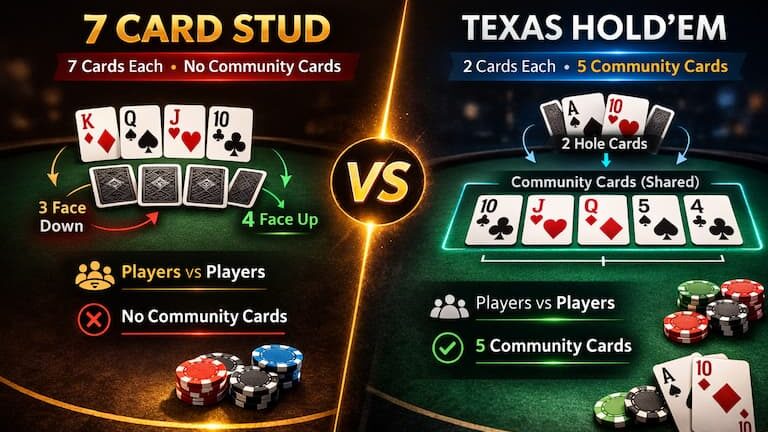
Seven-Card Stud is older than Texas Hold’em poker and dates back to the American Civil War in the 1860s. It evolved from the game Five-Card Stud, which was the original favorite among soldiers and riverboat gamblers. It was the king of poker from the early 1900s until the 1980s, before it declined in the late 1990s and continues to decline to this day because Texas Hold’em poker took over.
Texas Hold’em poker is faster, easier, and allows for no-limit betting, which creates more drama. So today, Seven-Card Stud is mostly played by old-school poker players. Below is a comparison table addressing the key differences between the two poker variations.
| Feature | 7 Card Stud | Texas Hold’em |
| Deck | 52-card standard deck (no jokers) | Same |
| Max Players | 8 (including the dealer) | 10 (including the dealer) |
| Card Distribution | 7 (3 hidden, 4 visible to others) | 7 (2 hidden, 5 community cards) |
| Community Cards | No | Yes, 5 |
| Opening Bets | Antes & Bring-In (Everyones bets, lowest card starts betting) | Blinds (Small Blind and Big Blind bet only) |
| Betting Structure | Fixed Limit | No Limit |
| Who Acts First? | Player with strongest visible cards | clockwise from the blinds |
| Primary Skill | Memory | Math & Psychology |
| Pace | Slow & Methodical | Fast & Aggressive |
| Winning | Best 5-card hand using only your private 7. | Best 5-card hand using your 2 and 5 community. |
So Which is Better?
Telling whether one game is better than the other is a bit heavy in the world of online poker because it’s all about preference. Texas Hold’em poker, on one hand, is fast-paced, has high drama, and offers more shared information you can use. You don’t have limits, and you can bully others by betting big.
Seven-Card Stud, on the other hand, is a more methodical old-school game where memory plays a bigger role than math and psychology. It’s more difficult to master, more complicated to learn, and definitely slower.
So, it’s all about preference. If you are looking for a fast-paced, aggressive game, then you should opt for Texas Hold’em poker. But if you prefer a more relaxed, strategic, slow-tracking game, then Seven-Card Stud is a better option for you.
7 Card Stud for Kuwaiti Players: A Final Verdict
So, is 7-Card Stud a good option for Kuwaiti players? The short answer is: it depends on their preferences. If you are a player with a good memory and a lot of patience, and you prefer these over luck and aggressive betting, then it could suit you well. If you’re also on a budget and don’t want to be bullied by limitless betting, that’s another plus.
One more thing: if you prefer a more private vibe in a game, where it’s not as exposing as other poker variations, then Seven-Card Stud is a good choice for you.
But the problem with Seven-Card Stud, being a classic old-school poker game, is that you won’t often find it on online poker sites in Kuwait. You can, for example, find a plethora of Texas Hold’em, Omaha, High-Low, or Caribbean Stud, but you may not always find many variations of Seven-Card Stud on these websites. So it would kind of limit your options.
- Skill Edge: If you have a good memory, you’ll dominate.
- Visible Info: You see half of everyone’s hand.
- More Action: Five betting rounds instead of four.
- Fairer Wins: No “community cards” helping everyone at once.
- Home Game Variety: Perfect for “wild card” variations.
- Exhausting: Tracking every folded card is hard work.
- Slow Pace: It takes a long time to deal and play.
- No All-Ins: Fixed limits mean you can’t “bully” with big bets.
- Player Cap: Strictly limited to 8 people or less.
- Tough for Rookies: Beginners get crushed by those who track cards.
7 Card Poker FAQs by Kuwaiti Players
What is a dead card in 7 Card Stud?
A dead card in 7 Card Stud poker is a card that has already been folded or cannot be dealt to any player because it has already been exposed and is no longer in play.
Why are there no community cards in Seven-Card Stud?
Seven-Card Stud is more of a private game. Each player is dealt seven individual cards (3 hidden, 4 visible to others). It does not use community cards like other games such as Texas Hold’em poker.
Where can I play 7 Card Stud in Kuwait?
Is Seven-Card Stud a game of luck or strategy?
Neither. 7 card poker is more of a game of memory and tracking. If you can track the dead cards and match them with the cards you need to create a strong hand, you have very good chances of winning.
What happens if two people have the same low card at the start?
If two players have deuces at the beginning, then the suit breaks the tie and decides who pays the bring-in. Clubs are the lowest, then Diamonds, then Hearts, and Spades are the highest. So if one of them has Clubs and the other has Hearts, the one with Clubs pays.
Me and my friends are 10 people. Can we play 7 Card Stud on one table?
No. 7-Card Stud uses a standard 52-card deck only, so you should have a maximum of 8 players. If you are more than 8, you have to split into two tables.
Is 7 Card Stud legal to play in Kuwait?
There are no land-based casinos in Kuwait, so you cannot play Seven-Card Stud in a physical casino inside the country. Kuwaiti players who choose to play usually do so on international online poker platforms, but they should always check the platform’s terms and local regulations before registering.


 Online Poker Sites
 Live Poker
 Poker Strategy
 Poker Games
 Poker Texas Holdem
 Blog
Blog