


Poker is a game of skill, patience, mathematics, and luck. Whether you are a beginner playing online or competing in major poker tournaments, there is a poker strategy for every type of player. On this page, we will discuss the fundamental concepts of poker strategies, pre-flop and post-flop strategies, the types of poker players, table dynamics, how you can transition between different poker playing styles, and common misconceptions that players often have. We will conclude with a final verdict and answer frequently asked questions by Kuwaiti players about poker strategies.

Bonus up to
$3,500

Bonus up to
$5,000

Bonus up to
$2,000

Bonus up to
$1,750

Bonus up to
$600

Bonus up to
$1,590

Bonus up to
$20,000

Bonus up to
$1,500

Bonus up to
$2,200

Bonus up to
$200

Bonus up to
€300

Bonus up to
$300

Bonus up to
$1,000

Bonus up to
$1,000

Bonus up to
$1,760

Bonus up to
$2,000

Bonus up to
$1,500

Bonus up to
$5,000
Fundamental Concepts of Poker Strategy
Before you choose and master a poker strategy, you need to understand the fundamentals of certain aspects of the game. For example: position, the size of the pot or the bet, being able to read what your opponent’s hand might be, a basic mathematical understanding of poker, and, finally, how to manage your bankroll. We will discuss each of these fundamental aspects of poker strategy below.
1. Position-Based Strategy
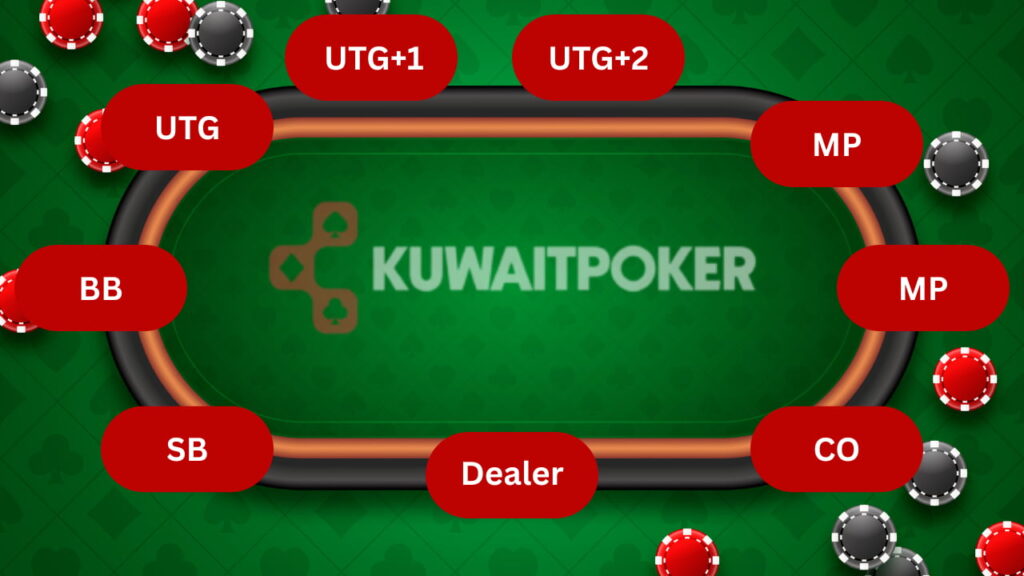
Your position at the poker table can really make or break your session. If you play in a late position, you can have more control over the pot and a better chance of stealing blinds from other players. Here’s why.
- Late Position (Cutoff / Button):
Acting late gives you a huge advantage because you can see what everyone else does, which helps you make your own decisions—so your choices are informed. You can use such positions to raise, steal blinds, and even apply pressure on your opponents. - Early Position (UTG / First to act):
Here, you should be much more selective in your poker strategies. Only strong hands like ♠️A ♥️A, ♣️K ♦️K or ♠️A ♠️K are worth playing. This is simply because acting first often means you are in the dark. You have no idea what others have, how they will play, or whether your hand is stronger than theirs. That’s why it’s usually better to play it safe unless you truly have a strong hand.
2. Bet Sizing
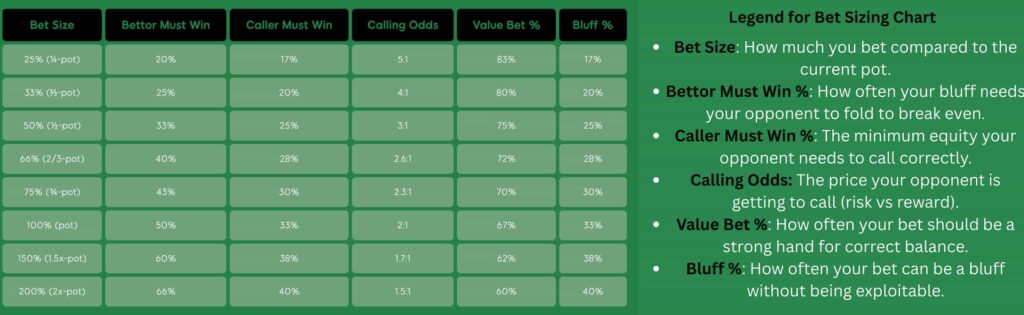
This is also an important fundamental of poker strategy. How much you bet is just as important as which hands you choose to play.
- Standard Approach: basically betting the default size, which is two-thirds of the pot. It works for most hands. It’s a standard bet amount. It doesn’t scare away your opponent and it still keeps your bets meaningful.
- Advanced Approach: in this approach, you bet depending on your goal. If you wish to make value bets, then you make bigger bets when you have stronger hands. If your goal is to bluff, then if you make smaller strategic bets, you can put pressure on your opponents without risking too much.
- Exploit your Opponents: in this case, you pay attention to how much your opponents are willing to call. For example, some players would fold at a two-thirds of the pot bet, but would call at smaller bets, so you can adjust your bet accordingly.
3. Hand Reading
Understanding the hands of other players is equally as important as understanding your own. Let’s take the below three scenarios.
- Scenario 1: If a TAG player raises from an early position online, he likely has strong hands (A♠️A♥️, K♠️K♦️, Q♣️Q♦️, A♠️K♠️). So in this case, you should only play premium hands and fold if you have weaker hands.
- Scenario 2: If a loose passive player calls from a late position, they probably have a wider range (9♣️7♣️, 8♦️6♦️, J♠️9♠️, Q♥️8♥️). They’re probably gonna use wider range. So in this case, you can raise to apply pressure because such types of Kuwaiti players, they fold more often and play weaker hands. So bluffing here works better.
- Scenario 3: If a player in the big blind checks to you after everyone folds, your poker strategy should be to raise with a wider range, even if you have medium pairs (7♠️7♥️, 8♣️8♦️) or suited connectors (6♠️5♠️, 9♥️8♥️), because the fold equity is high and they are likely not holding a strong hand.
- Scenario 4: If an aggressive player in a late position raises you, they probably have a wide range of hands. It could be premium, could be semi-bluff. What you should do here is, you should call if you have strong hands, like top pairs or better (A♣️K♣️, Q♠️Q♥️, J♦️J♣️), or re-raise as a bluff with a hand like suited connectors (7♣️6♣️, 8♦️7♦️) if they are capable of folding..
4. Poker Math Basics
In poker mathematics, there are formulas from beginner to advanced. You can calculate the pot odds up to calculating the hand combinations. There are complex formulas for each. There are so many mathematical equations. They are often not very practical. You cannot guess the exact number to apply a formula. But when you become an experienced player in poker, you can apply a mathematical poker strategy to improve your odds of winning. Take these three below, even a simple understanding of them can turn your poker session into a profitable one.
- Fold Equity Calculation: Estimate how often opponents will fold to your bet or raise.
- Formula: EV=(Fold Chance×Pot Size)−(Call Chance×Your Bet)
- Pot Odds & Break-even %: Decide whether to call or fold based on potential payoff vs risk.
- Formula: Break-even % = (Amount to Call ÷ (Pot Size + Amount to Call)) × 100
- Adjust Based on Opponents: If someone rarely folds, don’t bluff. If someone calls too often, value bet more.
- Formula: Adjusted EV=Base EV×Opponent Fold Factor
5. Bankroll Management
Smart players protect their money. Your bankroll is not just your cash; it’s your insurance against bad luck. And many Kuwaiti players tend to jump into high-stakes games too early. So following proper bankroll management would keep you in the game longer and stop you from burning out too early.
- In Cash Games: Keep $50–$100 buy-ins as a buffer.
- In Tournaments: Keep $100–$200 buy-ins to survive variance and swings.
Preflop Poker Strategy
Developing a preflop poker strategy is a key determinator of how the rest of your hand will play out. A strong preflop strategy is essential because it doesn’t just influence your hand selection, but also your style of play, whether you’re going to be aggressive or not. Thus, small adjustments before the flop, regardless of the type of table you’re playing—whether you’re with friends in a poker tournament or playing in Kuwait in online poker sites—can greatly affect your long-term winning rate.
With that said, let’s talk about 5 key fundamentals of preflop poker strategy: position, style, open/raise decisions, 3-bet or 4-bet, and adjusting.
Position Awareness
A core fundamental of the pre-flop poker strategy is to be aware of your position of play and what it signifies. We have spoken about this before, but let’s mention it again: the difference between an early position, a middle position, and a late position.
- Early Position (EP): In an early position, only stick to premium hands (A♠️A♥️, K♠️K♦️, Q♣️Q♦️, A♠️K♠️). You are acting first. It’s risky. You have no idea what others hold and what decisions they’re going to make. So do not make any mistake and only play if you have strong hands.
- Middle Position (MP): In this position, you have slightly more range. For example, strong aces (A♠️Q♠️, A♥️J♥️), Broadway hands (K♠️Q♠️, J♣️T♣️), and suited connectors (9♠️8♠️, 7♥️6♥️) can give you some flexibility while still maintaining a solid foundation for post-flop play.
- Late Position (LP – Cutoff / Button): This offers you a big advantage because you act last after most of the table has already folded or called. Their decisions are clear. Even their cards are clearer now. So you have a much wider range of hands to play, even if you have weaker aces (A♣️8♣️, A♦️5♦️), suited connectors (6♠️5♠️, 9♥️8♥️), or small pairs (4♣️4♦️, 5♠️5♥️). You can take a big advantage of the opportunities to steal the blinds or control the size of the pot.
Your Style of Play
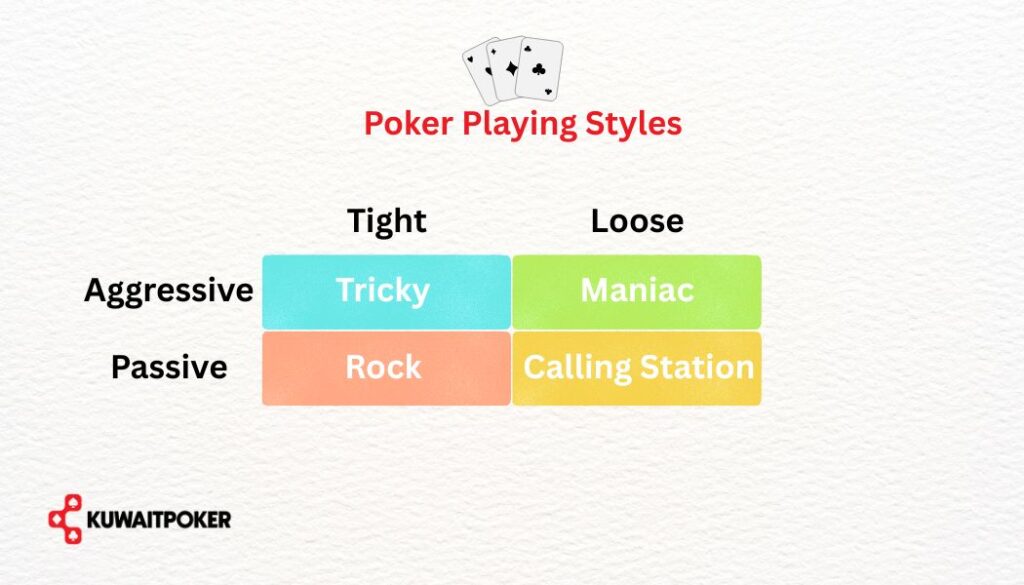
Now, your style of play also decides how you will handle your preflop poker strategy. We will talk about each style of play in much detail below, but for starters, let’s only talk about these three main styles of play and how they will affect your preflop poker strategy.
- TAG: If you’re a tight-aggressive player, you are likely to fold over 80% of your hands pre-flop, because you will be focusing on quality hands over the quantity of the cards that you have (A♠️A♥️, K♠️K♦️, Q♣️Q♦️, A♠️K♠️). So, you make your biggest decision pre-flop. If you have a strong hand, the post-flop decisions are going to become much easier and automatically more profitable.
- LAG: If you’re a loose-aggressive player, then you play more openly and play more hands (A♠️J♠️, K♦️Q♦️, 9♣️8♣️, 7♥️6♥️), thus applying constant pressure on the other players. Your key here is your position and your post-flop skills. That’s what makes this style of play more profitable.
- ABC Poker: This style emphasizes straightforward, fundamental play. The focus is on hands that are easy to navigate postflop, minimizing risk while still extracting value where possible.
Opening / Raising

Opening or raising in the preflop is a poker strategy that decides who’s taking control and dictating the pace of the hand.
- In an ABC strategy which is a standard poker strategy, you usually raise 2 to 3 times the big blind.
- If you are in a button or cutoff position, you have a good position to steal blinds, especially if the players are tight or passive—they are easy targets. So you can win small pots uncontested, and you build your image as an aggressive player.
- Hand examples for stealing blinds: A♠️5♠️, K♣️9♣️, Q♦️8♦️, J♥️7♥️
- If you’re a loose-aggressive player, then you will open earlier and with a wider range. You will force tight-aggressive players into difficult positions. For example, on the button against two tight blinds, you can raise with nearly any two cards (A♠️7♠️, 5♣️3♣️, 9♦️6♦️, 8♥️4♥️) and often take down the pot without a showdown, turning even marginal hands into immediate profit.
3-Bet / 4-Bet Strategy
Another preflop poker strategy fundamental is the re-raises, such as 3-bets, which is the second raise preflop, and the 4-bet, which is the third raise in the preflop round. Here’s when you should use each as a poker player playing at a competitive poker table:
- 3-Bet: If you suspect that a tight-aggressive player or an NIT player will fold, you should use a 3-bet (A♠️K♠️, Q♠️Q♦️, J♣️J♦️, 10♥️10♠️). This will probably allow you to win the pot immediately.
- 4-Bet: Reserve using this type of re-raise, either for when you have strong value hands (A♠️A♥️, K♠️K♦️, Q♣️Q♦️) or use them as a strategic bluff (7♣️6♣️, 8♦️7♦️) when playing against overly aggressive opponents. Why? Because it can force them to fold and you establish your dominance on the poker table.
- Adjust Sizes: Make sure you adjust the size of your re-raises. For example, if you have a strong hand, you can increase the size of the 3-bet or 4-bet, but if your goal is to bluff, then keep it at lower stakes.
Adjusting Preflop
It’s important to know that the pre-flop poker strategy is highly dynamic. You need to adjust it accordingly, based on the table and the tendencies of your opponents. You should read the table well, exploit the weaknesses of others, and make the most of your position.
Mastering this aspect of poker will give you a significant edge over others, no matter the type of table you are playing on.
Observe the player tendencies. Some players fold too often, while others call too much. Adjust your opening and re-raising ranges to exploit these patterns and maximize profitability., and opponent tendencies, you can start each hand with a clear plan that sets the stage for profitable decisions throughout.
For example, if you’re playing against aggressive 3-betters, you should tighten your range (A♠️A♥️, K♠️K♦️, Q♣️Q♦️, A♠️K♠️) to avoid tricky post-flop spots.
On the other hand, if you’re playing against passive players, you can expand your range (A♠️J♠️, 9♣️8♣️, 7♦️6♦️, K♥️Q♥️) and look for opportunities to steal blinds and small pots consistently.

Postflop Poker Strategy
After you have decided on your preflop poker strategy and set up the foundation for it, it’s time to continue with the flop round.
This will make or break your poker session. Unlike in the preflop, now you have more information about your opponent’s tendencies, and using it correctly will dramatically increase your win rate.
With that said, there are seven main aspects of the postflop poker strategy, which are continuation bets, barrels, value betting, pot control and building, bluffing, range thinking, and leverage. We will discuss each based on the style of play.
Continuation Bets (C-Bet)
Continuation bets, also known as C-bets, mean that you make a bet on the flop after having raised in the pre-flop round, regardless of whether your hand improved on the flop or not.
- ABC Style: For the ABC style of play, also in TAG, poker players are known to do C-bets around 60% of the time. Why? Because if they had raised in the pre-flop, it means they have a strong hand (A♠️K♠️, Q♣️Q♦️, J♠️J♥️), so they continue with it even if it didn’t improve on the flop when the community cards were dealt. So, bluffs are rare.
- LAG Style: Loose-aggressive Kuwaiti poker strategy players play more hands and bet aggressively, and they often bluff. They use C-bets even if it’s a dry board, just to force their opponents to fold and to take advantage of the tight-aggressive players’ predictable folding habits. So, in other words, LAGs use C-bets even if they don’t have a strong hand (7♣️6♣️, 9♦️8♦️, 5♠️4♠️), just so that they can pressure tight players.
Barreling
Barreling is a post-flop poker strategy whereby players continuously bet on two or more rounds—flop, turn, and river. The idea of barreling is to keep applying pressure on the opponents so that they fold weaker hands
If you’re a loose-aggressive player, then you will keep barreling until the others fold their marginal or medium-level hands (7♣️6♣️, 9♦️8♦️, 5♠️4♠️).
There is no direct rule for how ABC-style Kuwaiti poker players and tight-aggressive players barrel. The general rule is: if they have a strong hand, they barrel. And if the board texture favors their hand, they can barrel. The main goal is to protect your strong hand and avoid any unnecessary risk. Here’s an example:
Hold K♠️K♦️.
- Flop: 7♣️ 2♦️ K♥️ → bet $20 (first barrel)
- Turn: 5♠️ → check if the opponent shows strength; only bet again if confident → second barrel
Value Betting
Value betting is a type of poker strategy whereby you place a bet with the intention of getting paid by a hand worse than yours. The key in this type of poker strategy is to have an excellent understanding of your opponent’s tendencies. If you can read into their hands and predict what they are likely to do, then value betting with a strong hand is a good strategy for you.
- Game: No-Limit Texas Hold’em
- Your Hand: A♠ K♦️ (Top Pair, Top Kicker)
- The Board: A♥️ 8♣ 4♠ 2♥️ J♦️
- The Pot: $100
The action is on the River (the final card). You have been betting since the flop, and your opponent—a “calling station” who hates folding pairs—has called you every step of the way.
The board is relatively “dry,” meaning there are no obvious straights or flushes that completed. You are almost certain your Ace-King is the best hand.
You bet $60 into the $100 pot.
- Your Goal: You want your opponent to look at their hand—perhaps A♣ 10♠ (a weaker Ace) or J♣ J♥️ (a pair of Jacks that just improved)—and think, “I can’t fold top pair/second pair for that price,” and click Call.
- The Math: If they call with a worse hand more than 50% of the time, your bet has “positive expected value” ($+EV$).
Pot Control / Pot Building
One key poker strategy is to control the pot, because you don’t want to find yourself in a situation where the pot is getting bigger and, thus, so are the losses. The rule is simple: if you have big hands, like full houses (K♠️K♦️ + K♥️7♣️) or flushes (A♠️J♠️ + 7♠️3♠️ + 9♠️), you can opt for big pots. But if you have small or medium hands (8♣️8♦️, 9♠️7♠️), you should play for small pots. Now, you need to exercise pot control, and here’s how.
| Situation | Control the Pot (Check/Call) | Avoid Control (Bet/Raise) |
| Hand Strength | Medium-strength. Marginal hands like middle pair or top pair with a bad kicker. | Polarized. Either a very strong “monster” hand or a total bluff. |
| Board Texture | Dry. No obvious draws (K♣️7♦️2♠️ rainbow (all different suits)). The board is unlikely to change. | Wet. 9♠️8♠️7♥️ (straight & flush possibilities). You need to “charge” them to see cards. |
| Opponent Style | Aggressive/Maniac. They will interpret your check as weakness and bluff into you. | Passive/Calling Station. They won’t bet for you, but they’ll call if you lead out. |
| Position | In Position. You have the luxury of checking behind to see a free card. | Out of Position. It’s harder to control the flow, so betting often protects your equity better. |
| Stack Depth | Deep Stacks. Losing a “medium” hand for 200 big blinds is a disaster. | Short Stacks. When chips are low, you’re often “pot committed” anyway. |
Bluffing

Bluffing is a core poker strategy. The goal is simple: you don’t have the best hand, but you force others with stronger hands to fold. There are three types of bluffing: Pure Bluff (Air), Semi-Bluff, and Continuation Bet Bluff, and below is a table on when to use each.
| Bluff | Example | When to use | Remark |
| Pure Bluff (Air) | Nothing in hand, just betting | If the board is dry and opponents are likely to fold. | Dry Boards make it easier to bluff wet boards make it harder. |
| Semi-Bluff | Drawing hand (e.g., flush or straight draw) | If you can win by fold or improve your hand in then next round | If you are in Cutoff or Button it is easier to bluff |
| Continuation Bet Bluff | Flop C-bet with nothing after raising pre-flop | Best against tight players who fold often | Bluff more with TAGs and bluff less with LAGs |
Range Thinking
This is an advanced poker strategy for Kuwaiti players who have a lot of experience in the game already. It doesn’t limit the player to just thinking about their own hand against a single opponent’s hand. Instead, they consider the range of hands their opponents could hold (A♠️K♠️, Q♣️J♣️, 9♦️8♦️, 7♥️6♥️). And if you evaluate these ranges, you can make better decisions when it comes to bluffing, value betting, and folding. Such a mindset really allows you to exploit the tendencies of other players without needing to know the exact hole cards of each.
Leverage / Stack Management
Leverage is a poker strategy that is more like an art. You use your chips as a weapon to make your opponent’s life miserable. It’s very closely related to stack management, which is simply the awareness of how many chips you have and how many your opponents have compared to the pot. So, in other words, with leverage, you make the pot too big so that your opponent is terrified to play.
Leverage
You imply by making a big bet that an even bigger bet is coming. You might be signaling to other opponents that you will be betting your entire remaining $500 on the next card. This only works if you have a massive stack in front of you and the other opponents have a medium stack. It has a certain psychological effect on them because it forces them to fold medium-strength hands (K♠️10♠️, Q♦️9♦️, J♣️8♣️) since they don’t want to face a big decision on the river.
So, in other words, the bigger your stack relative to your opponents, the more you can bully them because you simply can’t afford to lose the pot, but they cannot. And that’s the leverage poker strategy summed up.
Stack Management

This can be decided based on a formula: Stack-to-Pot Ratio: SPR= Effective Stack Size/ Pot
If the SPR is high, 10 or above, this means that you have a deep stack. You have much more room for bluffing and leverage (A♠️K♠️, Q♣️J♣️, 9♦️8♦️). With a low SPR, under 3, that means you are committed. The pot is much bigger than your remaining chips, so you are going all-in regardless of the results. It’s already too late for you.
Poker Player Types and Styles

Understanding your opponents’ style of play and adhering to your own style is a key component of any solid poker strategy. Knowing whether your opponents are tight, aggressive, loose, or passive allows you to exploit their tendencies, adjust your ranges accordingly, and maximize your profits in every situation. For creative Kuwaiti poker players, this knowledge is also exceptionally valuable at online tables as well as live tables, even for those who wish to participate in competitive tournaments like WCOOP or WSOP. Below, we will talk in detail about each type of poker playing style.
Tight-Aggressive (TAG)
A tight-aggressive, or TAG, poker strategy is when a player plays few of the total hands that he or she is dealt. In fact, it’s known that TAGs fold 80% of the time. They do not play unless they are sure their hand is strong. This style of play is mostly suitable for beginners starting out their poker journey and trying to learn how to play poker well, because the TAG poker strategy has been proven successful. TAG players do not take big risks, they can win good money even at low stakes, and they heavily depend on their position at the table.

- Player Level: Beginner to Intermediate
- Characteristics: Tight, Aggressive, Disciplined & Predictable
- Actions in Each Round:
- Preflop: Folds weak hands and raises strong ones.
- Flop: C-bets often and may bluff on wet boards.
- Turn: Bets their strong hands and checks on marginal ones.
- River: Focuses on value betting strong hands.
- How to Beat A TAG:
- Steal their blinds when you are in a late position (even with a weak hand) and they are not, because they will most likely fold.
- Re-raise if you are on the button, even if they open from an early or middle position, because they will often fold to a re-raise.
- When a TAG makes a continuation bet and the board is dry, raise their c-bets. Even if they have a strong hand, they may fold it.
- A TAG’s Favourite Hands
When a TAG player does not fold in the preflop they likely have one of these hands:
| Position | Hand Type | Hands |
| Early Position (Under the Gun) | Premium Pairs | A♠️A♥️, K♠️K♦️, Q♣️Q♦️, J♠️J♥️ |
| Strong Aces | A♠️K♠️, A♥️Q♥️ | |
| Strong Pocket Pairs | 9♠️9♦️, 8♣️8♦️, 7♠️7♥️ | |
| Middle Position | Premium Pairs | A♠️A♥️, K♠️K♦️, Q♣️Q♦️ |
| Strong Aces | A♠️K♠️, A♦️Q♦️ | |
| Strongest Broadway Hands | A♣️Q♦️, K♠️Q♦️ | |
| Suited Connectors | J♠️T♠️, Q♥️T♥️ | |
| Late Position (Cutoff & Button) | Pocket Pairs | 5♣️5♦️, 6♠️6♥️, 9♦️9♣️ |
| Strong Aces | A♠️K♠️, A♥️Q♥️ | |
| Broadway Hands | K♣️J♦️, Q♠️T♦️ | |
| Suited Connectors | 9♠️8♠️, 7♥️6♥️ | |
| Suited Aces | A♣️9♣️, A♦️8♦️ |
- Strong hand selection
- Aggressive value betting
- Positional advantage awareness
- Avoids tricky situations
- Profitable against weak players
- Predictable play patterns
- Vulnerable to well-timed aggression
- Struggles against deceptive players
- Limited bluffing
- Over-reliance on position
Loose-Aggressive (LAG)
Loose Aggressive, or LAG, poker strategy is for more advanced Kuwaiti poker players with experience. These players are very dynamic and unpredictable and can adapt to various situations. They play a wide range of hands and bet and raise frequently. Bluffing is their friend. They can be a little vulnerable against very disciplined players who can read or call their bluffs. In general, LAGs can excel at poker if they have a good read on other players; if not, they are likely to make many mistakes.

- Player Level: Advanced
- Characteristics: Aggressive, Unpredictable, Opportunistic, Pressure-aplying & Risk-taker.
- Likely Actions by Round:
- Preflop: Raises and re-raises alot.
- Flop: C-bets often and forces others to fold and test others’ reactions and is likely to bluff even if their hands are weak.
- Turn: Applies pressure by barreling.
- River: Either value-bets strong hands or bluffs missed draws; can overbet to force folds.
- How to Beat A LAG:
- focus on strong hands only, tighten your hand range
- slow-play premium hands to fade out their aggression
- Call if you are in a position that lets you see what their action is. in other words catch their bluff even if your hand is not the best but good enough to beat their bluff, lags bluff a lot on weak hands
- LAG’s Favourite Hands
| Hand Type | Example |
| Premium Broadways | A♠K♠, A♥Q♥, K♦Q♦ |
| Medium to Small Pairs | 7♣7♦, 8♠8♥, 9♦9♣ |
| Suited Connectors | 6♠5♠, 7♥6♥, 9♣8♣ |
| Weak Aces / Suited One-Gappers | A♠5♠, K♥9♥, 5♣4♣ |
- Easily steals blinds and small pots
- Skillful at making opponents fold too often
- Exploits passive or tight players.
- Cannot guess their hands due to wide range
- Vulnerable to slow-played strong hands
- Plays too many weak hands
- Needs solid skills at reading others and experience to execute their poker strategy profitably
Nit Poker Strategy
Players who adopt a nit poker strategy are very tight and conservative players who rarely play hands unless they are certain that they have the best cards. They rarely bluff, and they fold very frequently, especially post-flop. So, they are very predictable but also frustrating to play against. Nits accumulate chips by waiting patiently for premium hands.

- Player Level: Beginner
- Characteristics: Cautious, Tight, Predictable, Disciplined & Conservative
- Likely Actions by Round:
- Preflop: Only plays premium hands otherwise they fold.
- Flop: Generally folds unless they hit a top pair
- Turn: Cautiously continues if hand is strong and rarely bluffs
- River: Value bets strong hands and still does not bluff. If hand is medium they fold.
- How to Beat A Nit:
- Raise if they are in the blinds spot even if you have a weak hand.
- If they raise and it’s your turn after them, re-raise with more hands to scare them.
- If they check the turn but then bet the river, raise them to force them to fold.
- Nit’s Favourite Hands
| Hand Type | Examples |
| Premium Pocket Pairs | A♠A♥, K♣K♦, Q♠Q♣ |
| Strong Ace Hands | A♠K♠, A♥K♦ |
| Medium Pocket Pairs | J♠J♥, T♣T♦, 9♠9♣ |
| Suited Face Cards | A♣Q♣, K♠Q♠ |
| Rare Speculative Hands | 7♠6♠, 5♥4♥, A♦3♦ |
- Extremely disciplined and patient
- Avoid major losses
- Very good at playing premium hands
- They are predictable and easy to bluff
- Do not take advantage of value betting opportunities
Maniac
A maniac is a type of player who use a very loose and aggressive poker strategy constantly betting and raising just to keep the action going, they generally do not have much skill and bully other players on the table.

- Player Level: Unskilled / Recreational
- Characteristics: Reckless, Loose, Aggressive, Unpredictable & Bully
- Likely Actions by Round:
- Preflop: Raises and re-raises very often with any two cards.
- Flop: Tries to check a lot and bets aggressively and is known to bluff.
- Turn: C-bets a lot and overbets even on weak hands.
- River: Pushes for large bets sometimes as a bluff and sometimes with an actual strong hand.
- A Maniac’s Favourite Hands: Here is a side note, maniacs do not have a favourite hand they would literally play anything, even the weakens of hands.
- How to Beat A Maniac:
- Avoid bluffing because they will call too often
- Adjust to their aggression by check-calling, overbetting value hands, and exploiting their predictable bluffs.
- Let them do most of the betting but try to keep the pot small
- Their relentless aggression allows them to win many small pots as they force players to fold.
- Opponents are more likely to “call them down” with marginal hands so they get paid nicely
- They make their opponents uncomfortable and prone to mistakes
- Their aggression is predictable
- They do not fold so they can go bankrupt easily
- They cannot adjust their poker strategy against opponents who refuse to fold
Calling Station
A calling station just like the name suggests a is a type of poker strategy whereby the player player calls a lot regardless of the hand they have and its strength. they avoid folding and are very predictable.

- Player Level: Beginner / Recreational
- Characteristics: Passive, Predictable, Risk-averse, Call-heavy & Frustrating
- Likely Actions by Round:
- Preflop: Calls, rarely bets
- Flop: Calls, rarely bets
- Turn: Calls, rarely raises
- River: Calls even if their hand is weak they may bet if they have a very strong hand.
- How to Beat A Calling Station:
- Do not bluff, they do not fold so it is pointless to bluff with a maniac.
- Bet for value even with medium-strength hands; they’ll call.
- In Preflop try to raise in a way your are head to head with a calling station cause their actions are predictable.
- A Calling Station‘s Favourite Hands: They do not care much about the hands they are dealt. They will call on anything.
- Hard to bluff against
- They call too much, so they occasionally hit lucky hands.
- Play too many weak hands
- Their actions are very predictable
GTO Wizard
A GTO Wizard is when you reach the big leagues in poker. It is a very advanced poker strategy and you need to be extremely experience d and disciplined and a math expert to be able to be a GTO Wizard in poker. A GTO Wizard is a player who tries to play perfectly balanced poker based on Game Theory Optimal (GTO) principles. They make decisions to make themselves as unexploitable as possible, mixing bluffs and value bets in mathematically correct proportions.

- Player Level: Pro Level/ Expert
- Characteristics: Balanced, Disciplined, Unexploitable, Calculating & Technical
- Likely Actions by Round:
- Preflop: Raise and 3-bet with a carefully chosen mix of strong hands and some bluffs.
- Flop: Check, bet, or raise based on their balanced range; includes both bluffs and value hands.
- Turn: Continue balanced play, adjusting sizing to maintain unexploitable ranges.
- River: Decide whether to bluff or value bet based on odds and opponent tendencies.
- How to Beat A GTO Wizard: GTO is a theory, the Kuwaiti poker players are still human so you can still identify their tendencies if you read them carefully. GTO is unbeatable but a player may deviate from the GTO so watch them
- A GTO Wizard‘s Favourite Hands: A GTO Wizard does not have preference when it comes to hands as they use a mix of strong hands, medium hands and bluffs.
- Very hard to exploit if you are a beginner
- Capable of making strong mathematical decisions
- Can adjust their poker strategy against any kind of player
- Predictable if you follow GTO too
ABC Player/ Standard Poker Strategy
An ABC poker player is a disciplined, straightforward, and fundamentally strong poker strategy whereby the player prioritizes consistency over fancy plays. They focus on solid hands, avoid unnecessary risks, and stick to a tight-aggressive style that works well against weak or recreational players. ABC players are predictable and rely on strong starting hands, position, and proper bet sizing to maximize value.

- Player Level: Beginner
- Characteristics: Disciplined, Predictable, Cautious, Fundamental, Tight
- Likely Actions by Round:
- Pre-flop: Play only strong hands (raise premium hands, fold weak ones)
- Flop: Bet or raise with strong hands, check or fold with weak/moderate hands
- Turn: Continue betting for value with strong hands, rarely bluff
- River: Value bet strong hands, avoid fancy plays
- How to Beat An ABC Poker Player:
- Play aggressively
- Bet frequently cause they fold if they do not havea premium hand
- An ABC Poker Player’s Favourite Hands: If they have these hands they will likely raise preflop.
| Hand Type | Examples |
| High Pairs | A♠A♥, K♠K♦, Q♣Q♦, J♥J♠ |
| High Suited Connectors | A♠K♠, A♥Q♥, A♦J♦, K♠Q♠, Q♥J♥, J♣10♣ |
| High Unsuited Connectors | A♠K♦, K♣Q♦, K♥J♠ |
| Other Strong Hands | A♣Q♣, K♦J♦, A♠J♠ |
- Plays solid fundamentals
- Minimizes costly mistakes
- Strong pre-flop and post-flop discipline
- Easy to extract value from weak opponents
- Predictable and exploitable
- Rarely bluffs
- Can be too cautious
- Hesitant to commit chips without strong hands
Poker Strategies for Kuwaitis: A Final Verdict
In conclusion, before you develop a poker strategy, you need to understand its fundamentals, starting with position, bet sizing, how to read hands, basic mathematics, and—most importantly—how to manage your bankroll. There are strategies for both pre-flop and post-flop play, and the way you act in these rounds will depend on the type of player you are. The main player types are TAG, LAG, Nit, Maniac, Calling Station, GTO Wizard, and ABC poker player.
Each type plays differently, and you must adjust your strategy based on your style and the type of player you are facing. Most beginners start as ABC players or Nits. They can gradually advance to TAG players, and with more experience, become LAG players. The ultimate experts, at the professional level, are the GTO Wizards.
FAQs By Kuwaitis About Poker Strategies
What is the best beginner poker strategy?
Most beginners in Kuwait start with an ABC poker strategy or a nit style of playing because it’s easy to follow. You just focus on your strong hands or premium ones, and all you have to do is understand your position at the table and act accordingly.
What is the difference between a TAG and a LAG poker strategy?
A TAG poker strategy is tight-aggressive. TAG players fold most of their weak hands and focus on strong ones. This strategy is ideal for beginners. LAG poker players are looser and equally aggressive. They play many hands, bluff often, and apply a lot of pressure on their opponents. This strategy is more suitable for experienced Kuwaiti poker players.
How important is position in a poker strategy?
Developing your poker strategy heavily relies on your position. The earlier you act, the more exposed you are and the less information you have. The later you act, the more information you gain, allowing you to see what other players have done and make more informed decisions.
Is bluffing an effective poker strategy online?
Generally, bluffing is a less effective poker strategy when playing online, but it still depends on the type of player you are facing. For example, bluffing is less effective against calling stations or maniacs, but it can be effective against beginner ABC players.
What are the best hands to play pre-flop?
Premium pairs (A♠️A♥️, K♠️K♦️, Q♣️Q♦️) strong suited connectors (A♠️K♠️, A♥️Q♥️) are the safest to play as a pre-flop poker strategy. They are mostly used by ABC and TAG players in Kuwait to build consistent winnings.
 Online Poker Sites
 Live Poker
 Poker Strategy
 Poker Games
 Poker Texas Holdem
 Blog
Blog