



Bluffing is considered an integral part of poker, as winning is not limited to holding the best cards. It also depends on the player’s constant ability to convince opponents that they have a strong hand, pushing them to fold.
With the shift from live poker tables, where physical tells and immediate reactions can be observed, to the digital environment, which is limited to usernames and silent numbers, a fundamental question arises about how effectively these maneuvers can be applied.
The direct answer is that Bluffing in online poker certainly works, and it is even considered a key pillar of long-term profitability. However, this success requires a shift toward adopting radically different tools and skills in the virtual environment.
The Fundamental Difference Between Live and Online Poker
The fundamental difference between live poker — whether in casinos or private diwaniya sessions — and online poker lies in the nature of the indicators used to analyze opponents’ playing styles. In live games, visual observation plays the biggest role in detecting bluffing, while the online playing environment requires reliance on purely technical and behavioral data.
Absence of Body Language
On online poker platforms, interaction takes place through usernames and avatars, which completely eliminates the possibility of observing players’ physical reactions that may reveal the strength or weakness of their cards, including:
- Hand movements: Trembling hands while handling poker chips, which often reflects nervousness.
- Eye contact: Excessive focus on the community cards or avoidance of eye contact.
- Physical changes: Changes in breathing speed or heart rate when receiving very strong cards.
This complete absence of visual indicators in online play leads some players to believe that applying or detecting bluffing is difficult. However, in reality, alternative indicators of a different kind have emerged.
Reliance on Digital Indicators
Instead of reading body language, evaluating opponents’ behavior in online poker in Kuwait depends on analyzing playing patterns, decision-making timing, and bet sizes. These indicators can be broken down into:
Decision-Making Timing
- Snap Call: When a player calls a bet almost instantly, this often indicates that they hold a medium-strength hand, or that they are waiting for a specific card to complete a draw, with a pre-existing intention to see the next card. This behavior rarely indicates a very strong hand, as strong hands usually require some thought to determine how to extract the maximum possible number of chips.
- Tanking: Taking a long time before choosing to check is often interpreted as a sign of weakness or surrender. By contrast, a long delay followed by a large raise may be an attempt to fake hesitation in order to disguise holding a very strong hand.
Bet Size Analysis
Bet size is one of the most important indicators for understanding the flow of play and the strength of an opponent’s hand.
- Very small bets — such as 10% or 20% of the pot — require careful analysis to determine whether they are intended to lure opponents into calling, or whether they are simply a low-cost bluff aimed at testing the strength of other players’ hands.
- Sudden changes in bet size on the River compared to the Flop or Turn often reveal inconsistencies in the player’s strategy. This inconsistency may create an opportunity for a re-raise to force the opponent to fold.
Effective Strategies for Bluffing in Online Poker
There are several methods used to execute Bluffing in online poker, but their effectiveness varies depending on the mathematical situation and the nature of the community cards on the table. To achieve the best results, bluffing strategies are classified into three main types based on risk assessment and profit potential:
Continuation Bet (C-Bet)
This is one of the most common and fundamental types of bluffing in modern poker strategy. The principle of the continuation bet is based on the player who took the initiative by raising before the Flop continuing to bet and maintain aggression after the Flop is revealed, regardless of whether the community cards have improved the strength of their hand or not.
The effectiveness of this approach lies in exploiting a statistical fact: opponents’ starting hands fail to connect with the Flop in roughly two-thirds of cases. Therefore, showing continued strength through a C-Bet often forces opponents to fold, allowing the player to win the accumulated pot without needing to hold a strong hand.
Semi-Bluffing
Semi-bluffing represents the safer and more profitable option, and it is considered a cornerstone of professional Bluffing in online poker. This tactic relies on betting aggressively with an incomplete hand that is not strong at the moment, but has a solid mathematical chance of improving into a winning hand in later rounds, such as waiting for one final card to complete a flush or a straight.
The semi-bluffing strategy offers two different ways to win:
- Fold Equity: The player wins the hand immediately if the opponent decides to fold under the pressure of the bet.
- Pot Equity: The player actually wins the hand on the Turn or River if the opponent continues playing and the required cards appear to complete the stronger hand.
Stone-Cold Bluffing
This refers to betting aggressively with a completely weak hand that has no current or future value, relying entirely on forcing the opponent to fold. This type is classified as a high-risk strategy, and overusing it should be avoided to prevent major losses.
The success of a stone-cold bluff depends on strict conditions, most importantly having a highly accurate reading of the community cards. It also requires targeting a specific type of player: cautious and disciplined opponents who tend to give up medium-strength hands once they face large bets.
Critical Factors for Ensuring Successful Bluffing in Online Poker
The success of Bluffing in online poker does not depend on luck or randomness. Instead, it is governed by precise factors that determine how and when this strategy should be executed. To ensure effectiveness and credibility, three key elements must be considered:
Position at the Table
Position at the table is one of the most important strategic advantages. Players in late positions have a clear edge because they make their decisions after observing the actions of the other players. When all previous players choose to check, this is a strong indicator of weakness and suggests that their starting hands have not connected with the Flop.
Taking advantage of these positions makes it possible to capture the pot with a calculated bet. In this case, the bluffing decision is based on actual information derived from opponents’ actions, making aggression from late positions more successful and less risky compared to early positions.
Reading the Nature of the Community Cards
Successful Bluffing in online poker depends on convincing opponents with a logical story that fully matches the exposed cards on the table. These cards can be divided into two types that determine how easy or difficult bluffing will be:
- Unconnected cards: For example, a board such as A-7-2 with different suits. Betting in this situation sends a clear and convincing message to opponents that the player holds an Ace. Bluffing in this spot is relatively easy and reliable, because opponents will usually fold immediately unless they hold a strong Ace that can withstand the pressure.
- Connected cards: This refers to cards that appear in consecutive ranks or share the same suit. Attempting to bluff in this situation is difficult and highly risky, because it requires convincing opponents that very strong combinations, such as a Straight or a Flush, have been completed, which is not always easy to believe.
Determining Bet Size
A common mistake is believing that Bluffing in online poker requires risking all chips with an all-in move to scare opponents. In reality, the ideal bet size requires a precise balance between risking the smallest possible number of chips and maintaining the credibility of the maneuver.
The golden rule is that the size of a bluff bet must fully match the size of the bet that would have been made when actually holding a winning hand.
If the usual strategy is to bet 50% to 60% of the pot when holding a strong hand, the same percentage should be used when bluffing. Any sudden or unjustified change in bet size will expose the inconsistency and push experienced players to call in order to uncover the attempt.
Target Selection: The Importance of Choosing the Right Opponent
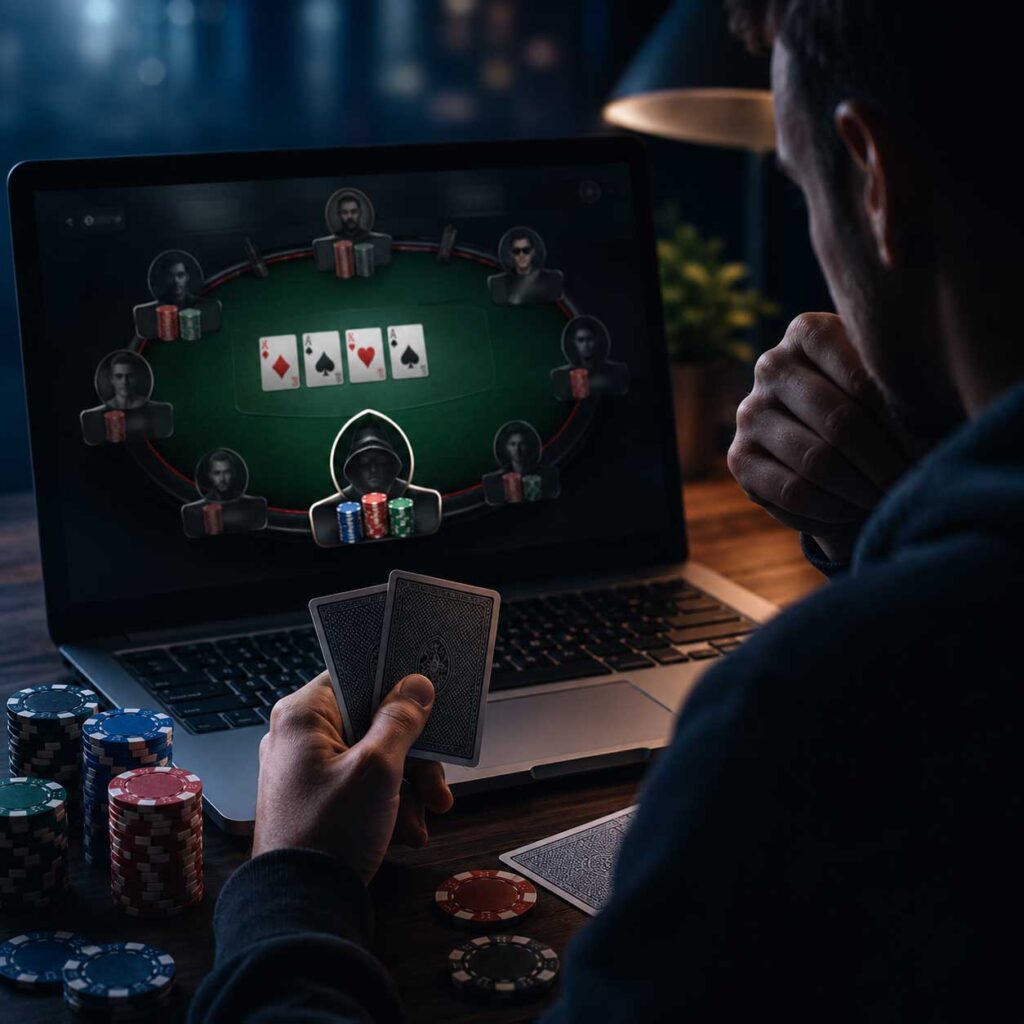
A successful Bluffing in online poker strategy is not complete simply because the player has good position or a board that supports the story being told. The other half of the equation depends on the nature of the targeted opponent. The golden rule in poker states that bluffing only works when the opponent has enough skill and awareness to fold their hand.
Based on this, opponents can be divided into two main categories when considering a bluffing strategy:
Calling Stations
The term Calling Stations refers to beginner or recreational players who refuse to fold and consistently call any bet, no matter how weak their cards are, simply out of curiosity to see the final cards. Attempting to bluff against this type of player is a losing decision and leads to chip depletion, because mathematical logic and bet-size signals mean nothing to them. The best strategy for dealing with them is to bet aggressively only when holding an actual winning hand.
Tight/Regular Players
This category includes experienced players, or those who follow a cautious playing style. They participate in only a limited number of carefully selected hands and calculate risks with precision.
These players are ideal targets for applying Bluffing in online poker strategies. Because of their experience, they can read bet strength and understand the “story” being told throughout the hand. Due to their usual caution and their desire to protect their chips, they can often be forced to give up medium-strength hands once they face continued pressure or a large bet in decisive rounds.
Conclusion: Building a Balanced Strategy in the World of Online Poker
The decisive answer to whether Bluffing in online poker works is: yes, absolutely. However, this practice no longer depends on spotting nervous glances or hand movements. Instead, it has evolved into an analytical skill based primarily on:
- Reading the numbers
- Tracking playing patterns
- Exploiting position at the table
- Carefully selecting the right type of opponents
To reach advanced levels of professionalism, overusing deceptive maneuvers as the only way to increase one’s balance should always be avoided. The better alternative is to integrate these maneuvers within what is known as a GTO strategy — Game Theory Optimal.
This advanced approach relies on balancing play in a way that makes it difficult for opponents to predict the next moves, by carefully mixing strong value betting with bluffing attempts only at decisive moments.
In the end, virtual tables rely on the language of information. The player who can collect and analyze digital data to build a logical and coherent “story” at the table is the one who maintains a lasting advantage and can turn weak hands into real, sustainable profits.


 Online Poker Sites
 Live Poker
 Poker Strategy
 Poker Games
 Poker Texas Holdem
 Blog
Blog