


Is Card Counting Possible in Poker?
Card counting in poker can be used to improve decision-making accuracy by tracking known cards and determining how many cards are still capable of changing the strength of a hand. This method does not provide certain knowledge of the cards that will come next, but it reduces the number of possibilities and provides better information about Outs, dead cards, and combinations that may still remain in play.
In this article, we focus on card counting in poker from a practical perspective, including remaining cards, Outs, probabilities, Pot Odds, Equity, Blockers, and hand ranges. We also explain how the value of this information differs depending on the structure of the poker game, the number of visible cards, and the size of the deck being used.
Sites Where You Can Play Poker

Bonus up to
$3,500

Bonus up to
$5,000

Bonus up to
$2,000

Bonus up to
$1,750

Bonus up to
$600

Bonus up to
$2,200

Bonus up to
$1,590

Bonus up to
$20,000

Bonus up to
$1,500

Bonus up to
$200

Bonus up to
€300

Bonus up to
$1,000

Bonus up to
$1,760

Bonus up to
$300

Bonus up to
$1,000

Bonus up to
$2,000

Bonus up to
$1,500

Bonus up to
$5,000
Information Available During Play
The accuracy of card counting in poker depends on the amount of information that becomes known during the hand. Every exposed card reduces the number of remaining possibilities, while hidden cards remain part of the uncertain information.
Many poker games use a standard 52-card deck divided into four suits, with each suit containing 13 cards. Some poker variants use a different number of cards, so calculations should always be based on the actual size of the deck being used.
| Element | Effect on the Calculation |
| Exposed Cards | Reduce the number of unknown outcomes |
| Number of Players | Increases the number of cards that are outside the remaining part of the deck |
| Hole Cards | Provide confirmed information that opponents do not have |
| Community Cards | Help evaluate hands and remaining probabilities |
| Exposed Opponent Cards | Reduce the number of combinations opponents can hold |
| Stage of the Hand | Determines how many cards are still able to appear |
Cards Remaining in the Deck
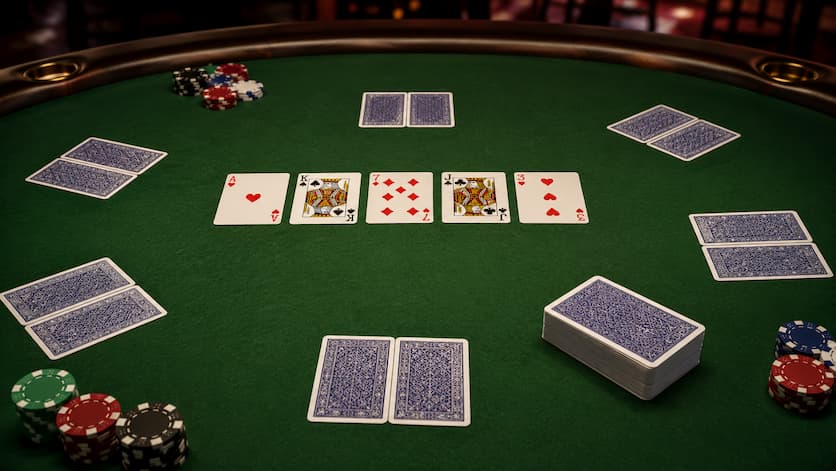
Card countingbegins with knowing the size of the deck and the number of cards that have become known. As the number of exposed cards increases, the number of possible outcomes that can appear later decreases.
This point is important when evaluating the chance of receiving a card that improves the hand. Having a certain number of useful cards is not enough on its own, because the value of that number also depends on the size of the unknown portion of the deck.
The value of this information increases in poker games that reveal a large number of cards during the hand. In contrast, the accuracy of card counting in poker decreases when most opponents’ cards remain hidden.
Outs and Cards That Can Improve the Hand
Outs represent the cards that can improve the current hand. They are among the most commonly used pieces of information in card counting but the raw number of Outs should not always be treated as the actual number of useful cards.
The number of Outs changes depending on the strength of the hand, exposed cards, cards that have already been removed from play, the number of opponents, and the likelihood that some of the same cards could also improve another opponent’s hand.
| Type of Out | Effect |
| Clean Outs | Cards that improve the hand with a good chance of keeping it as the strongest hand |
| Dirty Outs | Cards that improve the hand but may give an opponent a stronger hand |
| Shared Outs | Cards that lead to more than one type of improvement |
| Blocked Outs | Cards that are no longer available because they have appeared among the known cards |
One of the most important principles of card counting in poker is not to assign the same value to every Out. The presence of Dirty Outs or dead cards may make the actual chance of improvement lower than the number suggested by the initial count.
Probabilities Associated With Outs
After identifying the Outs, the chance of one of them appearing can be estimated based on the number of unknown cards and the number of remaining dealing stages. Players sometimes use quick estimates instead of detailed calculations during play.
| Number of Outs | One Card Remaining | Two Cards Remaining |
| 4 | About 8% | About 16% |
| 6 | About 12% | About 24% |
| 8 | About 16% | About 32% |
| 9 | About 18% | About 36% |
| 10 | About 20% | About 40% |
| 12 | About 24% | About 48% |
| 15 | About 30% | About 60% |
These figures are approximate, but they show why card counting in poker is connected to probabilities rather than simply knowing the number of remaining cards. Increasing the number of Outs raises the chance of improvement, but it does not necessarily increase the chance of winning by the same proportion.
Hand Improvement and Equity
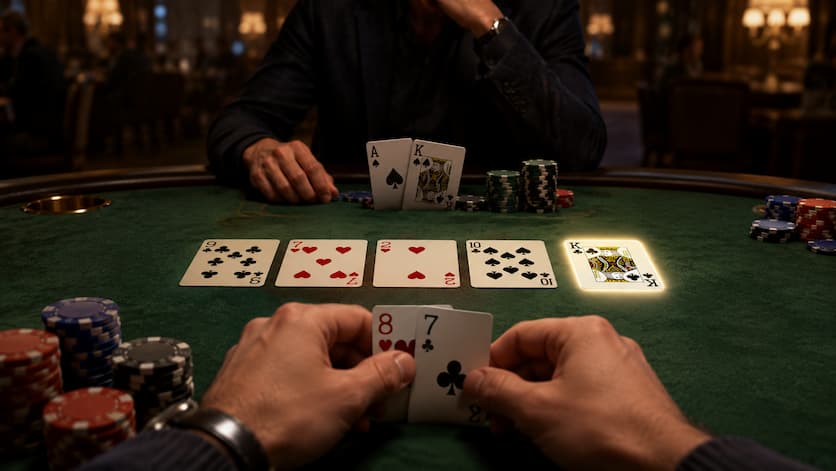
One of the most common mistakes when using card counting in poker is treating the chance of improving a hand as equal to the chance of winning. A useful card may appear, but the resulting hand may still be weaker than an opponent’s hand.
- Probability of Improvement: the chance of improving the current hand.
- Equity: the expected share of winning against a specific range of hands.
- Showdown Value: the value of the hand when reaching the final showdown.
- Fold Equity: the value generated by the possibility that an opponent folds before the showdown.
For this reason, card counting in poker is not used separately from reading an opponent’s range and evaluating the strength of the possible hands they may hold.
Pot Odds and the Cost of Continuing
Pot Odds help connect hand probabilities with the price required to continue. This stage makes card counting in poker more useful because knowing the chance of improvement alone does not determine whether paying the bet is mathematically appropriate.
| Opponent’s Bet Size Compared With the Pot | Approximate Equity Required |
| 25% of the Pot | 16.7% |
| 33% of the Pot | 20% |
| 50% of the Pot | 25% |
| 75% of the Pot | 30% |
| 100% of the Pot | 33.3% |
| 150% of the Pot | 37.5% |
| 200% of the Pot | 40% |
As the size of the bet required to continue increases, the Equity percentage needed to continue also increases. Therefore, several Outs may be available, but the cost of continuing with the hand can make the decision mathematically unsuitable.
Possible Hand Combinations
Card counting in poker is not limited to identifying the cards that may appear later. Known cards can also be used to reduce the number of combinations an opponent may hold.
| Hand Type | Number of Combinations Before Card Removal |
| Pocket Pair | 6 combinations |
| Hand With Two Different Ranks | 16 combinations |
| Suited | 4 combinations |
| Offsuit | 12 combinations |
When cards of a certain rank appear, the number of combinations containing that rank decreases. As the hand progresses, card counting in poker allows more hands that are no longer mathematically possible to be eliminated.
Calculating combinations is more accurate than trying to assume that an opponent holds one specific hand, because poker is a game of incomplete information and hidden cards cannot be known with certainty.
Blockers
Blockers play an important role in card counting in poker. The presence of a particular card among the known cards means that it cannot appear in another combination at the same time.
- Reduce the number of strong hand combinations.
- Reduce some flush combinations.
- Reduce some straight combinations.
- Narrow the range of hands capable of continuing against a large bet.
- Adjust the number of certain bluff combinations.
Having a Blocker does not mean that an opponent cannot hold a strong hand, but it reduces the number of combinations that allow them to hold certain hands. This makes the information more valuable when analyzing narrow ranges and large bets.
Opponent Ranges
Card counting in poker becomes more useful when combined with Range analysis. Instead of assigning one specific hand to an opponent, a group of hands that fit their decisions throughout the different stages of play is considered.
| Factor | Effect on the Range |
| Player Position | Affects the number of hands that can enter the pot |
| Bet Size | Helps narrow the range of hands |
| Number of Players | Affects the strength of hands required to continue |
| Stage of the Hand | Reduces the number of logical combinations as play progresses |
| Number of Raises | May indicate a narrower range |
| Playing Style | Determines how wide the player’s range may be |
| Bluff Frequency | Changes the proportion of weaker hands within the range |
Every known card eliminates part of the possible combinations. For this reason, card counting in poker can be used to continuously adjust an opponent’s range rather than relying on a fixed read established at the beginning of the hand.
Effect of the Number of Players
Card counting in poker becomes more complex as the number of participants in the hand increases. Each player holds private cards that have effectively been removed from the remaining portion of the deck, but they remain unknown as long as they are hidden.
These cards cannot be treated as specific Dead Cards because their values are unknown. Calculating Equity also becomes more complex because the hand must be compared against several different ranges rather than the range of only one player.
How the Value of Counting Differs Between Poker Games
The value of card counting in poker is not the same across all types of games. The most influential factor is the amount of card information that can be seen during the hand.
| Game Structure | Value of Tracking Cards |
| Games Based on Community Cards | High for calculating Outs and ranges |
| Games That Reveal Some Opponent Cards | Very high due to the greater amount of available information |
| Draw Games | Important for evaluating which cards are still available |
| Games Using a Short Deck | High because probability ratios change |
| Games That Deal Several Hole Cards | High for combination analysis |
As the proportion of visible cards increases, it becomes easier to eliminate certain outcomes. When most of the deck remains hidden, card counting in poker depends more heavily on probabilities and ranges rather than direct information.
Deck Size
Some poker games use a full 52-card deck, while others use a short deck. This difference directly affects card counting in poker and the probabilities of different hands appearing.
- The probabilities of forming certain hands change.
- The rarity of certain combinations increases or decreases.
- The relative strength of certain hands changes.
- Each known card has a different effect on the remaining deck.
For this reason, a single probability table cannot be used for every type of poker without taking the number of cards in the deck into account.
Dead Cards
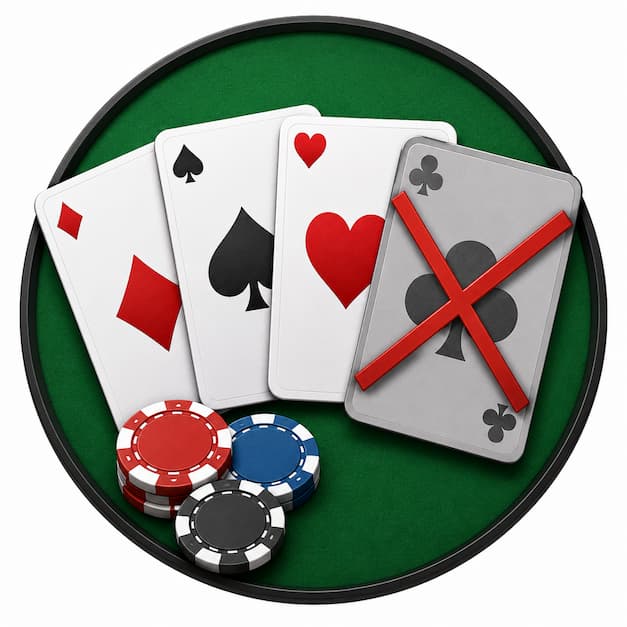
Dead Cards are an important part of card counting in poker because they are known cards that are no longer available to produce the required outcome.
Dead cards may include exposed cards held by opponents, discarded cards that have become known, cards visible as part of the game’s structure, or cards already present in the player’s own hand.
Every Dead Card related to the required hand reduces the number of available Outs. Ignoring these cards inflates the estimated chance of improvement and makes the mathematical calculation less accurate.
Reshuffling the Deck
When the deck is completely shuffled, previous hands provide little value for card counting in poker. Seeing a particular rank several times does not make it less likely to appear after the reshuffle, and its absence over several rounds does not mean it is due to appear in the next round.
The calculation should focus on cards related to the current deck. Relying on the results of previous hands after the deck has been reshuffled leads to estimates that are unrelated to the true probability.
Poker Analysis Tools
The basic part of card counting in poker can be performed mentally, especially when calculating Outs, Pot Odds, dead cards, and certain combinations.
More advanced analysis after play may include:
- Equity.
- Range vs Range.
- Expected Value or EV.
- The frequency of different decisions.
- Possible scenarios for upcoming cards.
- The effect of Blockers on combinations.
The poker platform’s terms should be reviewed before running any software at the same time as playing, because the rules concerning assistance tools differ from one platform to another.
Limits of Card Counting in Poker
Despite the usefulness of card counting in poker, there are still clear limits to the information that can be obtained. The calculation reduces the number of possibilities, but it does not turn hidden information into confirmed information.
- It does not reveal hidden cards accurately.
- It does not guarantee that a specific Out will appear.
- It does not determine an opponent’s next decision.
- It does not guarantee winning the hand.
- It does not reveal the order of the remaining cards.
- It does not eliminate the effect of bluffing or an opponent’s playing style.
Mistakes That Reduce Calculation Accuracy
Counting the Same Card More Than Once
A card that provides more than one type of improvement is still only one card. Counting it more than once incorrectly increases the number of Outs.
Not Adjusting the Number of Outs
The presence of Dirty Outs means that the actual number of useful cards is lower than the apparent number. For this reason, card counting in poker requires evaluating the quality of the Outs, not just their quantity.
Ignoring Dead Cards
Any known card that is no longer available should be excluded. Ignoring Dead Cards leads to probabilities that are higher than the actual values.
Treating Outs as Equal to Equity

Improving a hand does not necessarily mean winning it. Equity takes the strength of opponents’ ranges into account, not only the number of cards that improve the hand.
Ignoring the Cost of Continuing

Even when the chance of improvement is good, the bet size may be high enough to make continuing mathematically unsuitable.
Relying on Previous Hands
After a complete reshuffle, the results of previous hands do not change the probability of a particular card appearing in the new deck.
Key Elements of Card Counting in Poker
| Element | Use |
| Outs | Identify cards that may improve the hand |
| Dead Cards | Exclude cards that are no longer available |
| Pot Odds | Evaluate the cost of continuing |
| Equity | Estimate the chance of winning against an opponent’s range |
| Combos | Calculate the number of possible combinations |
| Blockers | Reduce the number of possible combinations an opponent may hold |
| Range | Identify the group of possible hands |
| EV | Evaluate the long-term value of a decision |
Conclusion
The value of card counting in poker appears when available information is used to reduce the number of possibilities and improve hand evaluation. Outs, dead cards, Pot Odds, Equity, combinations, and Blockers are all interconnected parts of this analysis.
As the amount of known card information increases, card counting in poker becomes more accurate. However, the result remains probabilistic because some cards remain hidden and the order of the deck cannot be known. Therefore, its value lies in identifying what remains possible and what has been eliminated, rather than trying to know the next card with certainty.
Frequently Asked Questions
Is card counting in poker legal?
Mentally calculating visible cards, Outs, and probabilities is not a problem by itself. Restrictions may apply to the use of external software that provides direct assistance during play, so the terms of the poker platform being used should be reviewed.
How accurate is card counting in poker?
The accuracy of card counting in poker depends on the amount of known card information and how Outs, dead cards, and Blockers are calculated. The calculation cannot reveal hidden cards or determine the next card with certainty.
Why are Blockers important in card counting in poker?
Blockers reduce the number of combinations an opponent can hold. The presence of a specific card among the known cards means it is no longer available in another combination, which helps narrow the range of possible hands.
What is the relationship between Pot Odds and card counting in poker?
Pot Odds are used to compare the cost of continuing with the required winning percentage. Therefore, card counting results, Outs, and Equity help determine whether the cost of continuing with the hand matches the available probabilities.
Do previous hands affect card counting in poker?
After the deck has been completely reshuffled, the results of previous hands do not provide reliable information about the new hand. Card counting in poker should be based on the cards and information related to the current deck.


 Online Poker Sites
 Live Poker
 Poker Strategy
 Poker Games
 Poker Texas Holdem
 Blog
Blog