


In poker, the strongest decision is not always made with the strongest hand. Sometimes, a Kuwaiti player has a hand that can improve, but the cost of calling is higher than its value. Other times, the hand is not complete yet, but the size of the pot makes calling a good mathematical decision. This is where Poker Math Basics become important, because they help the player evaluate Call or Fold based on price, probability, and expected value, not based on impression only.
In this article, we will explain Poker Math Basics through Pot Odds and EV, or Expected Value. We will show how a Kuwaiti player calculates the price of calling, how to connect that price with the number of cards that may improve the hand, how to use the Rule of 2 and 4, and when calling makes sense or folding is better. We will also cover Implied Odds and Reverse Implied Odds because they change Pot Odds decisions in many situations.
Our Recommended Casinos Where You Can Practice Poker Math Basics

Bonus up to
$3,500

Bonus up to
$5,000

Bonus up to
$2,000
Pot Odds and the Price of Calling

Here, we will not discuss how to play poker. Instead, we will talk about Pot Odds, which is the ratio that compares the cost of calling with the size of the pot after the call. As the first practical part of Poker Math Basics, the player does not only need to know that his hand can improve. He also needs to know whether the price he is paying is suitable for that chance.
Suppose the pot contains 30 KWD, the opponent bets 10 KWD, and the Kuwaiti player needs to pay 10 KWD to call. After the call, the pot becomes 50 KWD. Here, the equation is: 10 ÷ 50 = 20%
This means the player needs a winning chance of around 20% for the Call to be acceptable from a Pot Odds perspective. If the hand’s chance is higher than 20%, calling becomes stronger. If it is lower, Fold is usually better.
The important point here is that Poker Math Basics do not look at the Call amount alone. A 10 KWD call can be good in a large pot and bad in a small pot. The real price only appears when you compare the cost of calling with the final pot size.
Outs and the Rule of 2 and 4 in the Same Calculation
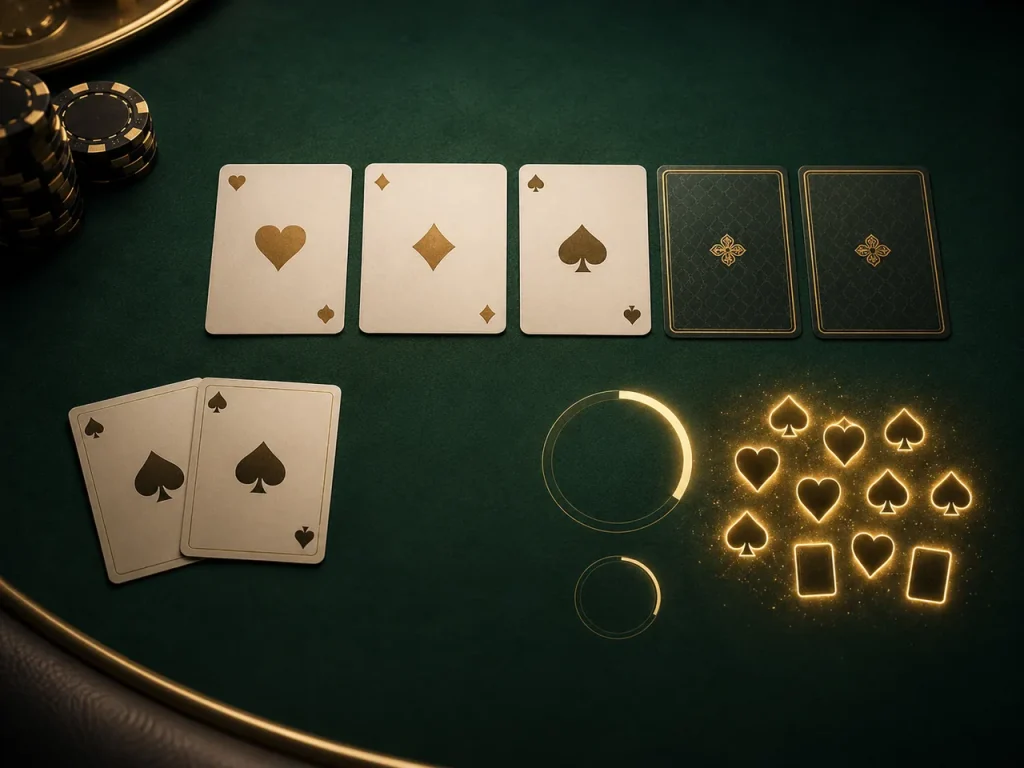
Outs are the cards that can improve a player’s hand. If the player has a Flush Draw, meaning he needs one card of the same suit to complete a Flush, and a Flush is five cards of the same suit, he may usually have 9 helpful cards.
But in Poker Math Basics, counting Outs alone is not enough. You must ask whether these cards are safe. If the player is chasing a low Flush, the hand may complete but still lose to a higher Flush. If there is more than one player in the pot, the chance of facing a stronger Draw or a made hand increases.
The Rule of 2 and 4 helps convert Outs into an approximate percentage:
- After the flop, the player multiplies the number of Outs by 4.
- After the turn, the player multiplies the number of Outs by 2.
If the player has 9 Outs after the flop: 9 × 4 = 36%
This means the chance of completing the hand by the river is around 36%. If the hand does not improve on the turn and only one card remains: 9 × 2 = 18%
Here, the decision changes. A hand that was worth a Call after the flop may not be worth a Call after the turn if the bet is large. That is why Poker Math Basics do not use one number throughout the entire hand. Every new street changes the calculation.
Connecting Pot Odds With the Chance of Improvement
A good Call decision starts with a direct comparison: the required price versus the chance of improvement. If the Pot Odds require 20%, and the player’s chance with Outs is around 36%, calling makes sense mathematically. But if the Pot Odds require 33%, and the player’s chance after the turn is around 18%, Fold becomes stronger.
This is the point that makes Poker Math Basics useful for a Kuwaiti player. It is not enough for the hand to be close to improving. Being close means nothing if the price is not suitable.
| Situation | Best Decision |
| Pot Odds require 20% and the chance of improvement is around 36% | Call can be good |
| Pot Odds require 33% and the chance of improvement is around 18% | Fold is usually better |
| Many Outs, but they are not safe | The decision needs caution |
| The price is good and the hand is usually strong if completed | Call is closer to +EV |
| The price is good, but the hand may become the second-best hand | The decision is risky despite the numbers |
This table connects Poker Math Basics directly with the decision. A Kuwaiti player does not need to memorize too many numbers. He needs to read the difference between the price and the chance.
EV and the Expected Value of a Decision
EV means Expected Value. This concept matters because Pot Odds alone are not always enough. Pot Odds give the price, while EV shows the quality of the decision if it is repeated many times.
A +EV decision means the decision is profitable in the long run. A -EV decision means the decision loses in the long run, even if it succeeds once. That is why Poker Math Basics do not judge a decision based on the result of one hand.
If a Kuwaiti player calls at a good price, and his chance is higher than the required percentage, then loses the hand, that does not make the decision bad. A short-term result does not cancel the quality of the calculation. And if he calls at a bad price and wins, that does not make the decision correct. Winning once does not turn a -EV decision into a good decision.
EV enters the calculation when the player asks:
- Is the chance of improvement higher than the price?
- Are the Outs safe?
- Could the opponent pay more if the hand is completed?
- Will the completed hand usually be the best hand?
- Does the bankroll size allow the decision without pressure?
This is how Poker Math Basics work in a practical way. The decision is not a Call just because the price looks good on the surface. It is a Call because the price, chance, and overall risk make it profitable when repeated.
Implied Odds Inside Pot Odds Decisions

Implied Odds means the extra money a player may win later if his hand is completed. This part adds more depth to Poker Math Basics, because current Pot Odds do not always show the full potential profit.
The current Pot Odds may not be perfect, but Call can become acceptable if the player expects to win extra money after completing the hand. This happens when the opponent is willing to pay later, and when the hand the player is chasing is not too obvious on the board.
Implied Odds become stronger when:
- The opponent has enough stack behind.
- The opponent pays often after the flop and turn.
- The card that completes the player’s hand does not look too scary.
- The player’s completed hand will usually be strong.
- The player is in a position that allows him to control the pot size.
But Implied Odds should not be used as a justification for any weak Call. If the card the player needs is too obvious, the opponent may stop paying. In this case, there is no real extra profit. Poker Math Basics need realistic judgment, not the assumption that the opponent will always pay.
Reverse Implied Odds and the Risk of the Second-Best Hand

Reverse Implied Odds means the money a player may lose later if his hand improves but remains the second-best hand. This is one of the most important details in Poker Math Basics because it explains why some Call decisions look good mathematically but are dangerous in practice.
If the player is chasing a low Flush, the needed card may come, but another opponent may have a higher Flush. In this case, the problem is not only the first Call, but also the extra bets the player may pay after completing his hand.
Danger signs in Reverse Implied Odds:
- More than one player is in the pot.
- A cautious opponent is betting strongly.
- The Draw is obvious on the board.
- The hand the player is chasing is not the Nut Hand, meaning it is not the strongest possible combination.
- The card that helps the player may help the opponent even more.
So when applying Poker Math Basics, the player should not only count Outs. He should ask: if my hand is completed, will I usually be ahead? If the answer is uncertain, the value of the Call should be reduced.
Practical Scenarios for the Kuwaiti Player
This section gives the Kuwaiti player short decisions that can be used while reviewing a hand or during play. The goal is to turn Poker Math Basics into clear situations, not a long theoretical explanation.
| When You Can Call | When Folding Is Better |
| When the hand’s chance is higher than the required price | When the cost of the Call is higher than the chance of improvement |
| When you have a strong Draw and safe Outs | When the Outs may give the opponent a stronger hand |
| When the bet is small compared to the pot size | When the bet is large and does not match the hand’s chance |
| When the hand will usually be best if completed | When the hand may complete and still remain second-best |
| When there are realistic Implied Odds | When the opponent will not pay if the hand is completed |
| When you are in a good position and have more information | When you are out of position and have no plan for the next street |
| When the decision is +EV when repeated | When the Call is made to recover a previous loss |
| When the bankroll allows a calm decision | When the table is bigger than the player’s budget |
This table is a practical tool inside the article. The Kuwaiti player can return to it to evaluate Call or Fold quickly, especially when the numbers are close.
How the Decision Differs Between Cash Games and Tournaments
Poker Math Basics apply to both cash games and tournaments, but the weight of the decision is different.
In cash games, the decision is closer to a direct financial calculation. If the Call is +EV, it is good in the long run because every bet has a clear cash value. That is why Pot Odds and EV are clearer.
In tournaments, stack situation and elimination risk must be added. A Call may be acceptable from a Pot Odds perspective, but dangerous if it threatens the player’s survival in the tournament. A Kuwaiti player in tournaments needs to use Poker Math Basics while also considering his position in the tournament, chip count, and stack size compared with opponents.
This does not mean the math changes. It means EV becomes broader. In tournaments, losing chips may be more expensive than their numerical value, especially near the prizes or when the stack is short.
Direct Mistakes in Pot Odds and EV
Relying Only on the Hand Name
Flush Draw or Straight Draw does not mean an automatic Call. A Straight is five consecutive cards, but it is not profitable if the price is bad or the Outs are unsafe. Poker Math Basics connect the hand name with the price and expected value, not only with the strong appearance of the hand.
Ignoring the Difference Between Flop and Turn
After the flop, two cards are still coming. After the turn, only one card remains. This clearly reduces the chance of improvement. A player who calls with the same logic in both stages is not applying Poker Math Basics accurately, because an acceptable price after the flop may become bad after the turn.
Judging the Decision by the Result
Winning does not mean the decision was correct, and losing does not mean the decision was wrong. EV evaluates the decision when repeated, not from the result of one hand. So a Call may be good despite losing, and a Call may be bad despite winning if the price was not suitable.
Using Implied Odds Without Proof

Do not assume that the opponent will pay later after your hand is completed. If the card that completes the hand is obvious or scary, the opponent may stop paying, and the Implied Odds become weak. Poker Math Basics need evidence from the opponent’s playing style and the remaining stack size.
Ignoring Stack Size
If one Call is large compared with the player’s bankroll, the decision becomes more psychological than mathematical. Fear of losing or the desire to recover previous losses can ruin the calculation. Poker Math Basics need a bankroll that allows the player to make the correct decision without excessive pressure.
Reviewing Call Decisions After Play
Improving the application of Poker Math Basics does not happen only during play. Post-session review is important because it reveals repeated mistakes in Pot Odds and EV.
A Kuwaiti player can review every hand where he called with a Draw using this method:
- Pot size before the Call decision.
- Cost of the Call.
- Pot size after calling.
- The required Pot Odds percentage.
- The realistic number of Outs.
- The quality of the Outs and how safe they are.
- The presence of Implied Odds or Reverse Implied Odds.
- Evaluating the decision as +EV or -EV.
This review turns Poker Math Basics into a real improvement tool. After several sessions, the player will start noticing that some Call decisions were repeated without a suitable price, or that some Fold decisions were correct even though the hand improved later.
Summary of Poker Math Basics
Poker Math Basics in Pot Odds and EV give the Kuwaiti player a clear way to evaluate Call and Fold. Pot Odds define the price. Outs define the chance of improvement. The Rule of 2 and 4 gives a quick estimate. EV shows whether the decision is profitable if repeated many times.
The real value is not in winning one hand, but in making correct decisions consistently. A good Call at a suitable price may lose once, but it remains a correct decision. A bad Call at a high price may win once, but it remains a losing decision in the long run.
When the Kuwaiti player connects the price, chance of improvement, quality of Outs, and EV, Poker Math Basics become a practical tool for protecting the bankroll and reducing random decisions. The goal is not to play too cautiously, but to call when the price is suitable and fold when continuing costs more than it is worth.
FAQs About Poker Math Basics
The Practical Difference Between Pot Odds and EV
Pot Odds define the price of calling in the current moment. EV determines whether the decision is profitable in the long run. In Poker Math Basics, Pot Odds are the starting point of the calculation, and EV is the final judgment on the quality of the decision.
Using the Rule of 2 and 4 in Every Hand
The Rule of 2 and 4 is used when the player has a clear Draw and an approximately known number of Outs. It should not be used with the same confidence when the Outs are unsafe or when the opponent’s possible hand is stronger.
Calling With a Flush Draw
A Flush Draw does not always mean Call. The decision depends on the price, the strength of the expected Flush, the number of players in the pot, and the possibility of a higher Flush. If the price is bad or the risk is high, Fold becomes better.
How Pot Odds Differ Between Cash Games and Tournaments
The basic calculation is the same, but tournaments require an additional consideration for stack value and elimination risk. In cash games, the decision is closer to a direct financial calculation, while in tournaments, a Call may be numerically correct but unsuitable for the player’s situation.
How to Know if a Decision Is +EV
A decision is closer to +EV when the hand’s chance is higher than the required price, the Outs are relatively safe, and there is a chance to win extra money without major risk. If the cost of calling is higher than the chance, or if the hand may become second-best, the decision leans toward -EV.


 Online Poker Sites
 Live Poker
 Poker Strategy
 Poker Games
 Poker Texas Holdem
 Blog
Blog