


Poker Etiquette for Kuwaiti Players: Professional Play Guide
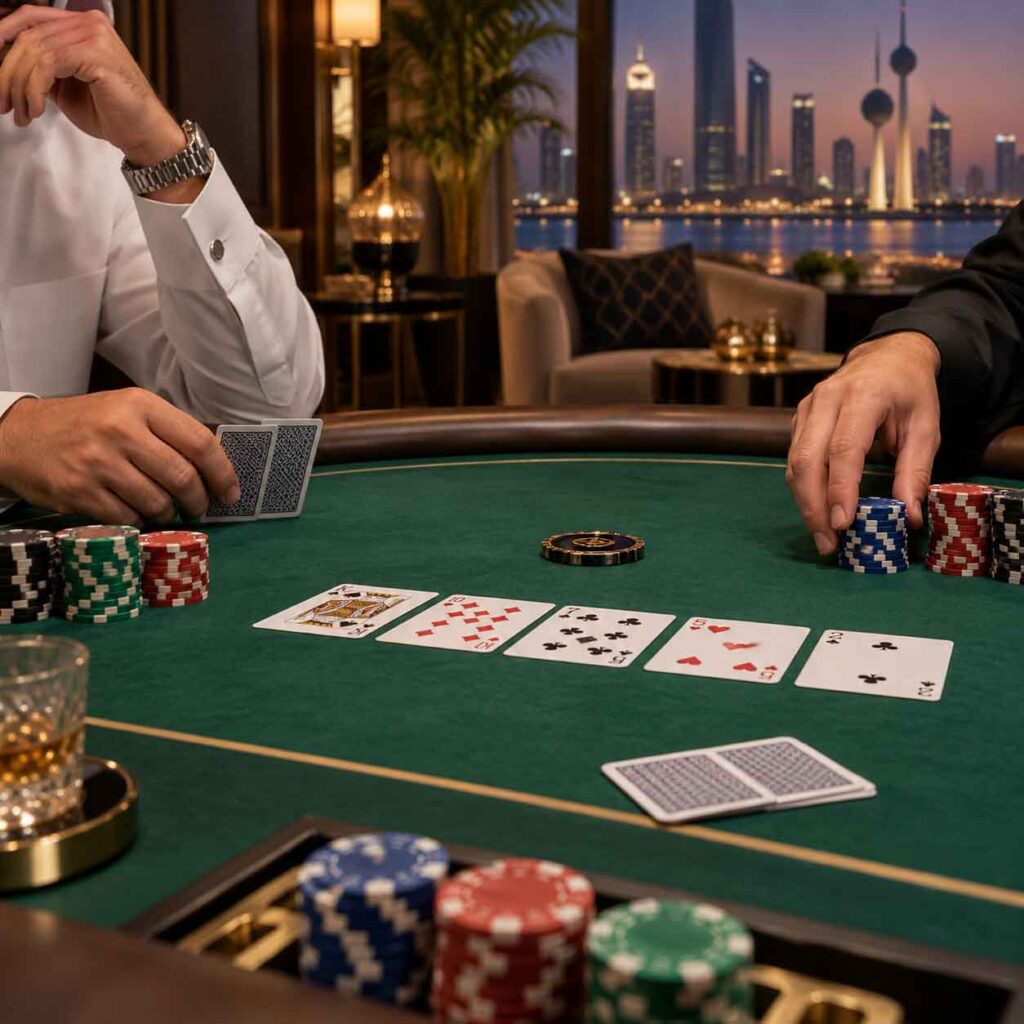
Poker is often viewed as a game of mathematical probabilities and psychological analysis, but the practical aspect that truly distinguishes professional players is behavioral discipline, or Poker Etiquette. This etiquette is not limited to simple politeness; it consists of organizational rules that ensure fair gameplay, prevent disputes, and protect you from revealing free information to your opponents that could negatively affect your focus and profits.
For Kuwaiti players, poker environments vary, and each requires a different level of behavioral awareness. These range from private “Diwaniya” sessions governed by discretion and social norms, to online platforms that demand digital discipline, and finally to international casinos with strict standards of conduct.
This guide covers the essential rules of Poker Etiquette, serving as a professional and practical reference to help you build an excellent reputation and maintain a strategic playing experience in any competitive environment.
Poker Etiquette at Live Tables
When playing at a live poker table, whether in a casino or a private session, your actions are governed by strict rules designed to protect the integrity of the game. Here are the most important principles of live Poker Etiquette that you should follow:
Strictly Follow the Turn Order:
This is one of the most important fundamentals of poker. Making any decision, such as betting, raising, or folding, before it is your turn gives other players free information they should not have and can directly influence their decisions. Always wait until the player before you has completely finished their action.
Avoid String Bets:
A string bet occurs when a player places chips into the betting area in multiple motions without first announcing the total amount of the bet. To avoid this mistake, which may result in part of your bet being ruled invalid, you should either clearly announce the full bet amount verbally or move all the required chips forward in a single motion.
Organizing Chips and Keeping Cards Visible:
Proper table etiquette requires you to organize your chips so that higher-value denominations are positioned where they are clearly visible to all players and the dealer. You should also keep your cards on the table and visible to indicate that you are still in the hand. Placing a small chip on top of them is recommended to prevent them from being collected by mistake.
Avoid Deliberate Delays:
A “Slow Roll” is the deliberate act of delaying the reveal of your hand when you are certain you have won, especially during the final showdown. This behavior is considered unsportsmanlike, provocative, and unprofessional. If you hold the winning hand and know that you have won, reveal your cards immediately out of respect for your opponent’s time and feelings.
Keep Table Talk Under Control:
While a hand is still in progress, you must not discuss details of the current hand or reveal the cards you folded while other players are still competing. Any hint, comment, or even physical reaction could influence the course of the game and affect another player’s chances, which is considered a serious breach of fair play.
Poker Etiquette Online
Despite the lack of physical interaction on online poker sites, following Poker Etiquette remains essential for ensuring a fair and efficient playing experience. Online poker moves at a fast pace and requires players to maintain a specific type of discipline, including the following rules:
- Managing Your Time Bank: Deliberately using up your available time to make obvious decisions is considered unprofessional behavior, especially in the early stages of tournaments or when approaching the prize bubble. The “time bank” should only be used when you genuinely need extra time to calculate complex odds or make critical decisions, not as a tool to frustrate your opponents.
- Multi-Tabling Responsibility: If you prefer playing at several tables simultaneously, it is your responsibility not to slow down the pace of play. Repeatedly delaying other players because your attention is divided between multiple tables is considered poor etiquette. It is recommended to enable “pre-action” options, such as Auto-Fold, to speed up your responses and avoid unnecessarily interrupting the game.
- Chat Box Discipline: The chat box is intended for limited and positive interaction. Insults, mocking less experienced players for their decisions, or constantly complaining about bad luck are strictly prohibited. The same rule that applies at live tables also applies here: discussing any hand that is still in progress in the chat box is strictly forbidden. Hostile behavior may result in restrictions being placed on your account by the casino operator.
- Use Interactive Features in Moderation: Many poker platforms provide interactive tools to make the experience more entertaining. Use these features sensibly and avoid repeatedly spamming them to distract or annoy opponents. Other players can simply mute these features, and excessive use may reflect poorly on your professionalism at the table.
Advanced Poker Etiquette
To improve your level of play and establish yourself as a highly professional player, there are several unwritten rules you should understand. These become especially important in private cash games and Diwaniya gatherings:
- Leaving Etiquette: One of the most frowned-upon behaviors in poker is winning a large amount and then immediately leaving the table. Proper Poker Etiquette calls for giving advance notice of your intention to leave, for example by saying, “I’ll play for another half hour” or “I’ll play two more rounds.” This gives the other players a fair opportunity to try to recover some of their losses and demonstrates respect for the group.
- Don’t Tap the Glass: This well-known strategic expression means avoiding criticism or ridicule of inexperienced players, often referred to as “Fish,” when they make poor decisions but still get lucky in the end. Embarrassing a beginner or giving them “free lessons” can ruin the atmosphere, cause them to play much more cautiously, or even make them leave the table, ultimately reducing the potential profits of more experienced players.
- Transparent Self-Dealing: In Diwaniya games where no professional dealer is present, players usually deal the cards themselves. To maintain fairness, the deck should be shuffled clearly above the table and then offered to the player next to the dealer to cut before the cards are dealt.
- Financial Boundaries and Borrowing: If you need to borrow money from a friend at the table in order to re-enter the game, proper etiquette requires you to settle the debt and repay the full amount as soon as the session ends. Mixing personal relationships with accumulated poker debts is a major reason many Diwaniya games come to an end.
Privacy and Cultural Considerations for Kuwaiti Players
In addition to universal poker rules, applying Poker Etiquette professionally also requires awareness of the cultural and social context of Kuwaiti players, whether in private local games or when playing in international casino venues.
Confidentiality and Financial Privacy
Kuwaiti society places a strong emphasis on discretion and respect for privacy in financial matters. It is considered inappropriate to ask other players about the size of their gambling budget, excessively boast about winnings, or constantly complain about losses. The focus should remain on the enjoyment and competitive nature of the game, rather than turning the table into a display of financial status.
Etiquette for Private “Diwaniya” Games:
The Diwaniya is one of the most common settings for playing poker among friends in Kuwait. To ensure these sessions remain enjoyable and well organized, the following rules should be observed:
- House Rules: Agree clearly in advance on the betting limits, the session’s start and end times, and any specific game rules before the first card is dealt. This helps prevent misunderstandings later.
- Keep the Game Separate from Friendship: Maintain a friendly atmosphere, as poker is a game that involves tactical deception (Bluffing). Avoid taking what happens during the game personally, as this can prevent unnecessary conflicts that may damage social relationships.
Travel and International Casino Etiquette:
When Kuwaiti players travel to participate in tournaments or cash games at major international venues, such as Las Vegas or London, there are several additional standards to keep in mind:
- Tipping: Tipping the dealer after winning a substantial pot is an important part of Poker Etiquette in international casinos and is often treated as a near-standard custom, even if it is not common in private games.
- Venue Rules: Strictly follow any dress code requirements, and avoid using your mobile phone or speaking in a foreign language that the dealer and other players cannot understand while you are involved in an active hand. Casinos enforce these rules strictly to prevent any possibility of collusion.
Unethical Tricks and Practices to Avoid
Although poker fundamentally relies on legitimate tactical deception, there is a clear and firm line between smart strategy and unethical practices, commonly known in the poker community as “Angle Shooting.”
What Is Angle Shooting?
Angle Shooting is the deliberate exploitation of loopholes in the rules or the use of ambiguous physical or verbal actions to confuse an opponent or obtain unfair information from their reaction. Although these actions may not qualify as outright cheating, such as switching cards, they are considered among the most serious violations of Poker Etiquette. Common examples include:
- Pretending to Fold: Making a quick motion that suggests you are throwing away your cards in order to induce the next player to act, then stopping and keeping your hand.
- Hiding High-Value Chips: Deliberately placing high-denomination chips behind lower-value chips to make opponents believe your stack is smaller than it actually is.
- Verbal Ambiguity: Muttering the word “Call,” then throwing in higher-value chips and pretending that you actually intended to raise (Raise).
Discretion and Equal Disclosure of Information
One of poker’s golden rules is: “Show one, show all.” If you fold your cards and choose to reveal them to the player sitting next to you, even if that player is a close friend, you must also show them to everyone else at the table and to the dealer. Giving information to one player while withholding it from others undermines the principle of equal opportunity and is considered unfair behavior.
Why Does Angle Shooting Damage Your Reputation?
The poker community, particularly in Kuwait’s private games and Diwaniya sessions, is built primarily on mutual trust and fair play. Resorting to these tactics may give you an advantage in a single hand, but it can cost you your reputation in the long run. A player known for Angle Shooting is often viewed as undesirable at the table, which can lead to being excluded from private-game invitations and avoided by experienced players in competitive settings.
Conclusion: Your Reputation Is Your Real Capital at the Poker Table
In the end, Poker Etiquette is more than just a set of formal rules; it is what separates an amateur player from a professional who earns the respect of everyone at the table. Mastering the game requires more than mathematical skill and bluffing strategies; it also demands self-discipline and respect for the playing environment and your opponents.
Poker is a long-term strategy game. Luck may change and profits may fluctuate from one session to another, but your reputation as a fair and professional player is one of your most valuable assets. A player who consistently follows proper standards of conduct will always be welcome at the table, will have a better chance of being invited to profitable private games, and will be less likely to encounter disputes at international casinos or on online poker platforms.

 Online Poker Sites
 Live Poker
 Poker Strategy
 Poker Games
 Poker Texas Holdem
 Blog
Blog