


Poker Software for Assistance
Poker assistance software includes a variety of tools used to record hands, track results, calculate probabilities, review decisions after a session, study strategy, and identify recurring mistakes in a player’s approach. These programs do not all serve the same purpose. Some are designed for off-table study, while others operate during live play. Whether they may be used depends on the type of tool, how it is used, and the poker platform’s rules at that time.
In this article, we will cover the main types of poker assistance software, the function of each type, and the most popular tools used in each category. We will also explain the differences between hand trackers, Heads-Up Displays (HUDs), equity calculators, and solvers. In addition, we will discuss restrictions during live play, prohibited tools, criteria for choosing the right software, differences between free and paid options, and the privacy and security of gameplay data.
Sites Where You Can Play Poker

Bonus up to
$3,500

Bonus up to
$5,000

Bonus up to
$2,000

Bonus up to
$1,750

Bonus up to
$600

Bonus up to
$2,200

Bonus up to
$1,590

Bonus up to
$20,000

Bonus up to
$1,500

Bonus up to
$200

Bonus up to
€300

Bonus up to
$1,000

Bonus up to
$1,760

Bonus up to
$300

Bonus up to
$1,000

Bonus up to
$2,000

Bonus up to
$1,500

Bonus up to
$5,000
Main Functions of Poker Assistance Software
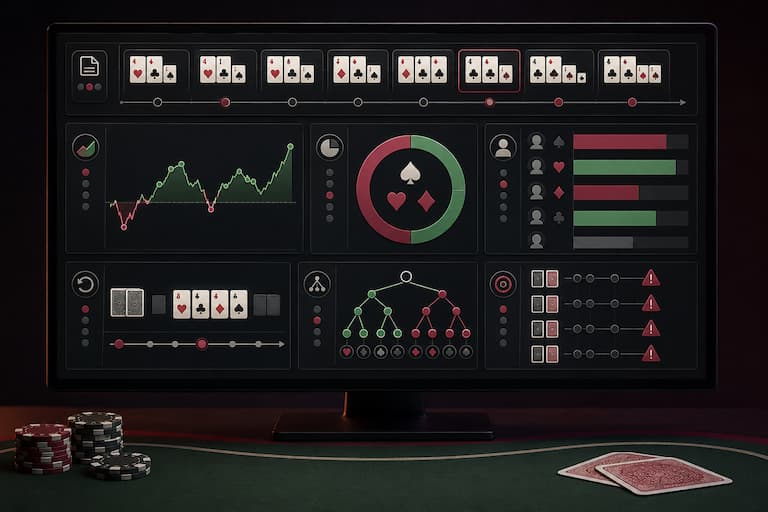
Most poker assistance programs perform a range of essential tasks:
- Automatically recording and saving previous hands from Hand History files.
- Tracking profits and losses across different sessions and periods.
- Calculating equity and winning probabilities for a hand or range of hands.
- Displaying statistics about the playing style of the player or their opponents.
- Reviewing decisions after the session has ended.
- Simulating different poker situations and poker strategies for training purposes.
- Identifying recurring decision-making mistakes across a large number of hands.
Some poker assistance programs are designed exclusively for off-table use, while certain platforms allow limited tracking features during play. This distinction is important because confusing the two is one of the most common reasons for violating platform rules.
Main Categories of Poker Software
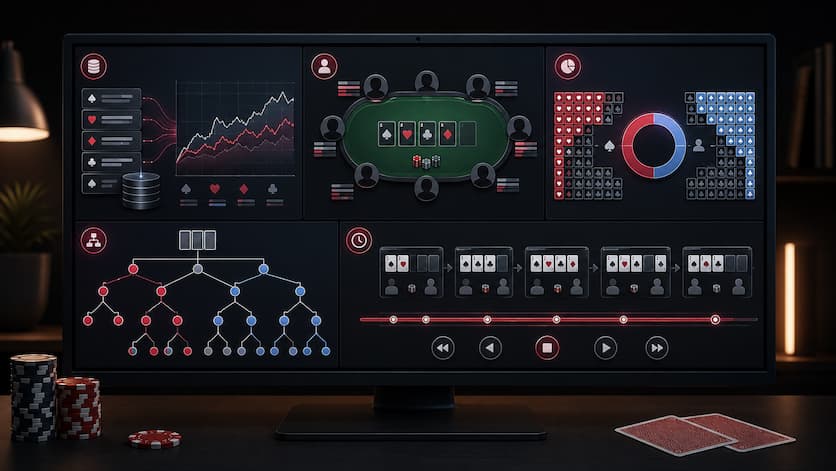
Poker assistance software can be divided into clear categories, each serving a different purpose and suiting a specific player level.
Hand and Results Tracking Software
Hand tracking software imports Hand History files and builds a complete database of previous sessions. Some of the most important statistics it displays include:
- Voluntarily Put Money in Pot (VPIP) percentage.
- Preflop Raise (PFR) percentage.
- 3-Bet percentage.
- Aggression Factor.
- Win Rate.
- Number of hands played.
These statistics only become reliable after a sufficient number of hands has been collected, as results from a small sample may reflect random variance more than a player’s actual playing style.
Heads-Up Displays
A Heads-Up Display (HUD) shows selected statistics next to each player’s name directly at the table. It is important to distinguish between displaying permitted historical data and providing real-time recommendations about the current decision, which is not allowed on most platforms.
Platform policies regarding HUDs vary significantly. Some prohibit them entirely, some permit a limited version, and others restrict certain statistics while allowing others. These policies are not fixed and may change over time, so they should be reviewed regularly before every session.
Equity Calculators
An Equity Calculator compares a hand or range of hands against another range and estimates the probabilities of winning, losing, and tying. Here is a simplified example:
- Player’s hand: A♠ K♠.
- Community cards: 10♠ 7♦ 2♠.
- Estimated opponent range: Medium to high pocket pairs.
- Approximate equity result: Around 45% in favor of the player.
When the opponent’s range is changed to a narrower range containing only stronger hands, the equity percentage decreases noticeably. This demonstrates that an equity calculator provides a mathematical result based solely on the assumptions entered and does not determine the correct strategic decision on its own.
Solvers and Strategy Analysis
Solver software studies balanced strategies associated with the concept of Game Theory Optimal (GTO) play. The main concepts related to it include:
- Ranges: The set of possible hands for each player.
- Bet Sizes: The available betting options at each stage.
- Frequencies: How often each decision is used within the strategy.
- Expected Value (EV): The expected return from a specific decision.
- Game Tree: A representation of all possible paths within a hand.
Solver results depend on the accuracy of the assumptions entered, such as ranges and available bet sizes. Therefore, its outputs should not be copied literally into real situations where the circumstances differ from the original assumptions.
Training Tools and Hand Replayers
Training tools and Hand Replayers help kuwaiti players review decisions step by step, repeat specific situations, practice recurring scenarios, and build an organized study routine away from the pressure of live play.
Comparison of Poker Assistance Software Categories
| Software Category | Main Function | Use During Live Play | Difficulty Level | Best Suited For |
| Hand Tracker | Recording and analyzing hands and results | Depends on platform policy | Low to medium | All levels |
| HUD | Displaying historical statistics at the table | Depends on platform policy | Medium | Kuwaiti Players active at multiple tables |
| Equity Calculator | Calculating winning and losing probabilities | Usually off-table | Medium | All levels |
| Solver | Analyzing balanced strategies (GTO) | Not intended for use during play | High | Advanced Kuwaiti players |
| Hand Replayer | Reviewing decisions after a session | No | Low | Beginners and intermediate Kuwaiti players |
| Training Software | Training for specific scenarios | No | Medium | All levels |
It is important to note that this table does not definitively classify tools as permitted or prohibited. Permission depends on each platform’s policy and may change at any time.
Examples of Poker Assistance Software
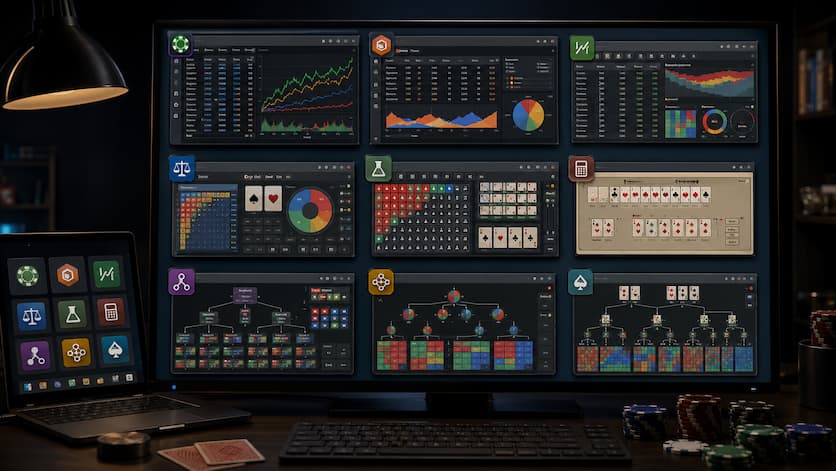
- PokerTracker: A Hand Tracker used to analyze hands and build detailed reports. It is suitable for intermediate and advanced kuwaiti players and includes optional HUD features. Its strengths include the depth of its statistical reports, while one limitation is that using it to its full potential requires a prior understanding of statistics.
- Holdem Manager: Also falls under the Hand Tracker and HUD categories and suits kuwaiti players who play at multiple tables simultaneously. Its strengths include processing large volumes of hands quickly, while one limitation is that some of its advanced features may conflict with the policies of certain platforms.
- Hand2Note: Tracking and HUD software designed particularly for analyzing opponents’ patterns and suitable for advanced kuwaiti players. Its strengths include precise behavioral classifications, while one limitation is the need for a large sample of hands to produce accurate results.
- Equilab: A free equity calculator aimed at beginners and intermediate kuwaiti players and primarily used for off-table study. Its strengths include ease of use, while one limitation is its restricted analysis compared with solver software.
- Flopzilla: An equity calculator and range analysis tool suitable for intermediate kuwaiti players who want to understand the distribution of hands within a particular range. Its strengths include clear range visualization, while one limitation is that it does not provide balanced strategic solutions like a solver.
- PokerStove: An older, free equity calculator suitable for beginners learning the basics of probability calculation. Its strengths include simplicity, while one limitation is that its interface and updates are less advanced than those of modern tools.
- PioSOLVER: One of the best-known solver programs, suitable for advanced kuwaiti players who want to study GTO strategies in depth. Its strengths include calculation accuracy and flexibility in configuring assumptions, while its limitations include a steep learning curve and high computational requirements.
- GTO+: Another solver used to analyze balanced strategies and suitable for advanced Kuwaiti players. Its strengths include faster calculations in some cases compared with similar programs, while one limitation is that the quality of its results depends heavily on the accuracy of the inputs.
- Simple Postflop: A solver tool mainly designed to analyze postflop stages and suitable for intermediate and advanced kuwaiti players. Its strengths include a clear focus on a specific stage of the hand, while one limitation is its restricted preflop analysis.
All these programs are primarily designed for use outside live playing sessions, and none should be regarded as the absolute best option. The choice depends on the player’s objective and level, the game type, and the rules of the platform on which they play.
Permitted Analysis Tools and Prohibited RTA Tools
It is important to distinguish clearly between different levels of use:
- Reviewing hands after the session has ended.
- Using historical information permitted by the platform.
- Consulting static charts when the platform permits it.
- Receiving an automated recommendation during an active hand.
- Using Real-Time Assistance (RTA) to analyze the current situation.
RTA tools analyze an active hand and suggest an action such as Check, Bet, Call, Raise, or Fold. This is the main reason most poker platforms prohibit this type of tool.
Activities considered high-risk or prohibited on most platforms include:
- Entering an active hand into solver software during play.
- Using software that directly recommends the next action.
- Using shared or purchased databases containing information about opponents.
- Using software designed to conceal prohibited tools from the platform.
- Using software that makes or executes decisions automatically.
This article does not provide any instructions for bypassing platform detection systems. Any use of RTA tools remains the player’s sole responsibility and may expose them to immediate penalties.
Poker Platform Policies and Usage Limits
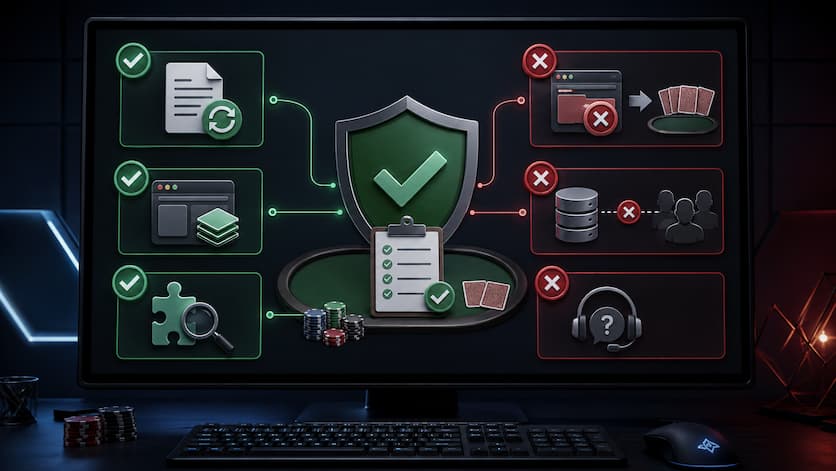
Rules concerning permitted and prohibited poker assistance software vary from one platform to another, and these rules may change over time without prior notice. Therefore, the current policy of each platform should be reviewed before installing or running any tool.
A quick checklist before using any poker assistance software:
- Read the platform’s latest rules regarding permitted software.
- Confirm that the specific program and version are permitted.
- Check that plugins or add-ons do not introduce prohibited features.
- Close prohibited study tools before starting a session.
- Do not import external databases about opponents.
- Contact platform support if any rule is unclear.
Reading Statistics Without Drawing Misleading Conclusions
Repeated analytical mistakes can lead to inaccurate conclusions. The most notable include:
- Judging a player based on a very small number of recorded hands.
- Interpreting VPIP or PFR separately from the context of other statistics.
- Ignoring the game format and table size when making comparisons.
- Comparing Cash Game results with Tournament results without distinguishing between them.
- Ignoring the Stakes and Rake percentage.
- Confusing short-term results with the actual quality of decisions.
- Treating All-in EV as a guarantee of future profit.
For example, a sample of 50 hands is generally insufficient to assess a particular opponent’s playing style reliably, while a sample of several thousand hands provides a more accurate picture of their actual style and recurring tendencies.
Criteria for Choosing the Right Poker Assistance Software
When choosing poker assistance software, the following factors should be considered:
- Game format: Cash games or tournaments.
- Poker variant: Texas Hold’em or Omaha.
- Main objective: Tracking results, studying GTO, calculating equity, or reviewing hands.
- Compatibility with the operating system being used.
- Compatibility with the playing platform and its Hand History files.
- Ease of use.
- The player’s level of experience.
- Price and licensing model.
- Update frequency.
- Privacy policy and database security.
- Whether its features are permitted during actual play.
For Beginners
Simple tools such as basic equity calculators and hand replayers are suitable for beginners, helping them build an initial understanding of probability and range concepts without unnecessary complexity.
For Intermediate Players

Intermediate Kuwaiti players can benefit from combining tracking software with range analysis to review their playing style and identify recurring mistakes more accurately.
For Advanced Players

Advanced kuwaiti players often need specialized solver software alongside advanced tracking tools to study balanced strategies and analyze complex situations in greater depth.
In all cases, no single program is suitable for every player. The best choice depends on the player’s objective, experience level, and preferred game type.
Free and Paid Poker Assistance Software
| Criterion | Free Software | Paid Software |
| Number of features | Limited to moderate | Broader and more detailed |
| Hand History file limits | May be restricted | Usually higher or unrestricted |
| Supported games and platforms | Relatively limited | Usually broader |
| Updates | Less frequent | More regular |
| Reporting tools | Basic | Advanced and detailed |
| Analysis speed | Suitable for basic use | Faster when handling large datasets |
| Technical support | Limited or unavailable | Included with most paid packages |
| Licensing model | Usually completely free | Recurring subscription or one-time purchase |
A free option is usually sufficient for a beginner who wants to understand the fundamentals without paying. A paid program becomes worthwhile when the player needs advanced reports, support for large amounts of data, or ongoing technical assistance. This article does not provide specific prices because they vary and change regularly.
Privacy and Security of Gameplay Data
Hand History files and poker assistance software databases may contain usernames, financial results, personal notes, and detailed session records. This information is sensitive and requires proper protection.
Practical security measures include:
- Downloading the software only from its official source.
- Avoiding counterfeit or unofficial copies.
- Updating the software regularly.
- Protecting the database with a password or specific access permissions.
- Creating encrypted backups when necessary.
- Reviewing the permissions of any plugin before installing it.
- Avoiding sharing files containing sensitive information with untrusted parties.
- Using strong passwords for accounts associated with the software and platform.
A Practical Study Plan Using Poker Assistance Software
- Clearly define the objective of the analysis before starting.
- Import hands or select specific situations to study.
- Review decisions involving large pots and important situations.
- Compare ranges and their associated equity results.
- Use solver software outside active playing sessions when necessary.
- Record recurring mistakes identified during the review.
- Develop simple and clear rules for future decisions.
- Review the results after collecting a sufficient number of new hands.
The objective of this plan is to improve the player’s decision-making process, not to find a ready-made automated answer for every hand they encounter.
Common Mistakes When Using Poker Assistance Software

- Purchasing advanced software before understanding poker fundamentals: The solution is to focus first on the theoretical fundamentals before investing in complex tools.
- Running several programs without a clear objective: The solution is to define the study objective before opening any tool.
- Copying solver results literally: The solution is to use the results as a reference for understanding and adapt them to the context of each actual situation.
- Trusting statistics based on small samples: The solution is to wait until a sufficient number of hands has been collected before drawing conclusions.
- Ignoring the effect of Rake on results: The solution is to include the rake in any realistic assessment of profits.
- Using software without checking the platform’s rules: The solution is to review the platform’s current policy before every use.
- Confusing study tools with RTA tools: The solution is to ensure that the tool does not operate or provide recommendations during an active hand.
- Storing a database without sufficient protection or backups: The solution is to enable regular backups and protect access to the files.
Conclusion on Poker Assistance Software
The value of any poker assistance program is directly connected to the user’s objective and how it is used, rather than to the software itself. Tracking, calculation, and analysis tools support an organized study process, but they do not replace an understanding of poker fundamentals, decision-making ability, risk management, or the availability of sufficient data for drawing reliable conclusions.
Before running any tool, checking the platform’s latest rules remains an essential step that cannot be ignored. Kuwaiti players must also avoid any software that provides prohibited real-time decisions or recommendations during live play.
Frequently Asked Questions About Poker Assistance Software
Is poker assistance software permitted during live play?
This depends on the type of software and the specific platform’s policy. Some historical tracking tools are permitted on certain platforms, while Real-Time Assistance (RTA) tools are prohibited on most platforms because they analyze the active hand and suggest a direct action.
What is the difference between a HUD and a solver?
A HUD displays historical player statistics directly at the table during play, while a solver is mainly used off-table to study balanced strategies based on GTO concepts. The first is a data-display tool, while the second is an in-depth strategic analysis tool.
Does poker assistance software guarantee profits?
No, none of these programs guarantees a win or profit. They are analysis and study tools that can improve decision quality over time, but final results are affected by many other factors, including opponents’ skill levels and random variance in the game.
Is free software available for analyzing poker hands?
Yes, free tools such as basic equity calculators can help beginners understand probabilities and ranges. These tools are suitable for getting started, but they are generally less detailed than paid software when advanced analysis or comprehensive reports are required.
Why do poker platforms prohibit RTA tools?
Real-Time Assistance tools are prohibited because they analyze the current situation and suggest a direct action, such as betting or folding, during an active hand. This gives their users an unfair advantage over Kuwaiti players who rely solely on their own decisions.



 Online Poker Sites
 Live Poker
 Poker Strategy
 Poker Games
 Poker Texas Holdem
 Blog
Blog